7 Strategies for Creating Culturally Inclusive Internal Communications

A famous metaphor goes that “words cut deeper than a knife.” Unfortunately, even one tiny, culturally inappropriate word or gesture (you’ll find some examples in this blog post) has enough power to emotionally wound your employees and spoil corporate relationships. Adding fuel to the fire: it can sabotage employee experience or—as if that weren’t bad enough—exclude the person from the team entirely.
In fact, 20% of workers (every fifth!) don’t feel included in their organizations. That’s why workplace inclusion has long turned from a trivial catchphrase into a strategic task for companies aiming to achieve employee success.
In this article, we’ll talk about how to “sow” cultural inclusion in employee communications and make it take root in any work environment by giving it enough “nutrients” to survive and grow fuller. You reap what you sow, as they say.
So, let’s start planting the proper seeds of culturally inclusive communication in your company.
What Is Cultural Inclusion in Internal Comms?
Cultural inclusion in corporate communication is an atmosphere where everyone has an equal opportunity and right to participate in conversations, be heard, and feel respected and valued regardless of their background.
Employees, especially in today’s multinational workplaces following the globalization vector, may come from diverse cultures and have various backgrounds:
- Geographical (urban, suburban, rural)
- Ethnic and racial
- Religious
- Heritage and tradition-driven (e.g., traditional clothing like the kilt in Scotland or the sari in most of the South Asian countries)
- Linguistic (languages and dialects)
- Societal (e.g., different subcultures or strata of society)
- And others.
Cultural diversity like this grants a multitude of perks, from attracting the best candidates to gaining better employee engagement rates to generating sky-high revenues. “Highly inclusive” organizations are 120 times more likely to meet their financial goals and generate 1.4 times higher profits on average.
But along with diversity comes the need for equity and inclusion, forming the DEI triad. Let’s discuss the latter in detail from a cultural perspective.
Your Ultimate Guide to Culturally Inclusive Workplace Communication
Here’s how you can help employees from diverse cultural environments communicate and collaborate agreeably and harmoniously.
Drop stereotypes and boost multicultural awareness.
You’re probably thinking: “That’s not about our team. Our internal comms are free from cultural prejudices and biases.”
However, the trickiest thing about stereotypes is that they can be unconscious, too. Your employees may unknowingly use them in internal communication because they have been deeply ingrained into their minds.
For instance, look at these unintentional assumptions about different nations and ethnicities:
- All Brazilians are great dancers.
- Jamaicans are always relaxed and carefree.
- Canadian people are overly polite.
How can you fight conscious and unconscious culture-based stereotypes in your in-office or remote team’s internal communications?
“The sooner you begin educating your team about cultural nuances and raising multicultural awareness in the workplace,” notes Lifei Chen, Founder at buysmart.ai “the cleaner your internal communications will be from stereotypical judgments and remarks.” He recommends taking a more curated rather than scattered approach:
“Creating a structured cultural awareness program can help you systematize and coordinate this process. It can take the format of educational modules dedicated to specific topics around one or several cultures: historical heritage, social norms, communication etiquette (in-person and digital), traditions, holidays, and so on.”
Alternatively, explore ready-made programs relevant to your company.
For example:
Diversity Australia offers an Indigenous Cultural Awareness program for organizations with Aboriginal and Torres Strait Islander employees.

Let your team members share their unique stories.
Where do your employees come from? What are their cultural backgrounds?
Bet your team members would have so much to tell! Why not roll out an employee storytelling initiative and bring cultural inclusion into your internal communication this way?
Such practice will considerably speed up cross-cultural exchange within your company. Your employees can prepare “My Story” videos or “Culture of the Month” presentations to share with teammates. It would be even more beneficial if you could later publish those on social media with their permission, leveraging employee advocacy and positioning your company as a culturally diverse and inclusive workplace.
For example:
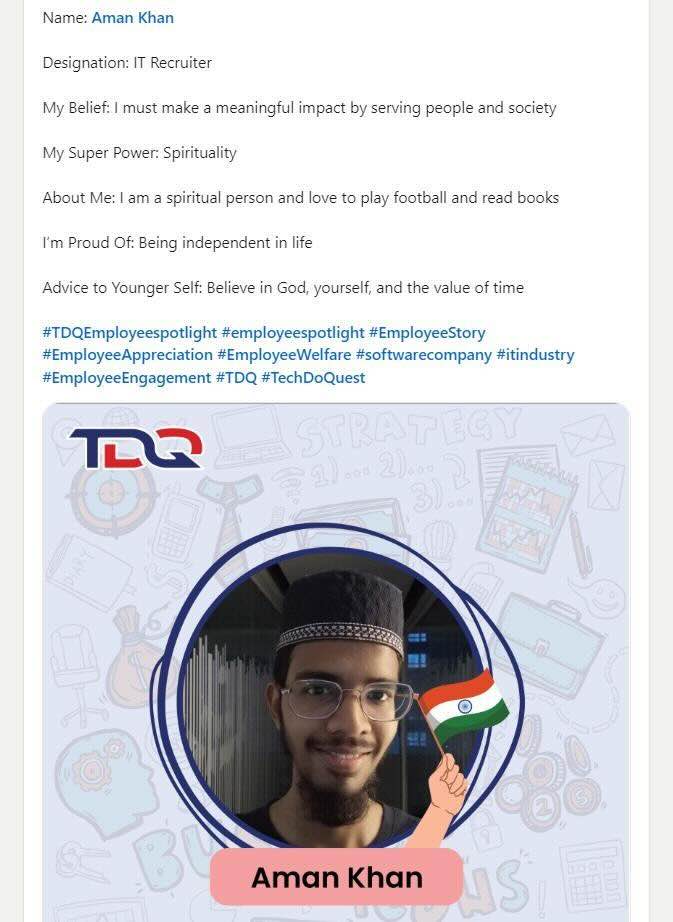
While embarking on cultural storytelling with the #employeestory hashtag, TechDoQuest shares employee profiles with their beliefs, values, and flag symbols near the photos to indicate the country of origin.
Develop employees’ communication skills.
What if your workers simply lack an essential skill set for successful team communication across cultures?
Sabas Lin, CTO at Knowee, claims, “Cross-cultural employee communication presupposes accumulating a certain bank of skills (verbal and nonverbal); both are acquirable and worth mastering. Whether your staffers come from different countries or the same country but from different walks of life, economic classes, or sub-communities, you must train them to interact respectfully and seal all possible communication gaps.”
Verbal skills for cross-cultural internal communication
The topmost are:
- Cultural sensitivity → Handle culturally sensitive discussions cautiously.
- Clarity and simplicity → Steer away from idioms or culturally specific references that cause misunderstandings.
- Stylistics → Adjust your communication style (formal or casual).
- Active listening → Listen attentively and clarify if needed.
- Culturally inclusive language → Replace a culturally biased vocabulary with an inclusive glossary.
For example:
Biased: tribe, Chinese whispers.
Inclusive: Use “team” instead of “tribe” and “telephone game” instead of “Chinese whispers.”
Nonverbal skills for cross-cultural internal communication
Culturally inclusive internal comms are not solely about words. Such interactions also span non-verbal aspects like these:
- Personal space (proximity to the speaker)
- Body language
- Facial expressions
- Eye contact
- Touches
- Gestures, etc.
For example:
A thumbs-up (an indicator of a great job in the US or Europe) can be interpreted as an insulting gesture in the Middle East or Greece.
Implement an anti-discriminatory policy.
You won’t ever be able to cultivate cultural inclusion in team communication if your employees don’t know what you exactly anticipate from them and what they might be doing or saying wrong.
As Jacob Barnes, Founder of FlowSavvy, specifies, “What many employers still overlook these days is an anti-discriminatory policy, a document that outlines rules and expectations to employees and removes ambiguities for more inclusive internal communication.”
If you also left it out of your attention, he provides a possible “skeleton” with key components for preparing your set of standards and principles. According to Jacob Barnes, anti-discriminatory policies traditionally include the following:
- Purpose (e.g., to prevent cultural or any other discrimination in the company)
- Scope (the policy applies to employees/contractors/stakeholders…)
- Usage (meetings, presentations, emails, intranet, corporate events)
- Key definitions
- Guidelines for respectful and culturally inclusive communication
- A list of unacceptable behaviors
- Feedback and reporting mechanisms (create confidential channels for reporting discriminatory statements or behavior in the workplace)
- Disciplinary measures in case of violations
When you have the policy in place, make sure to distribute it to all employees via a corporate knowledge base, email, or handbook. Also, remember to review and update the policy regularly based on previous incidents and organizational or cultural changes in your company.
Translate and localize whenever necessary.
This strategy majorly concerns written internal communication.
If you want your corporate content to fully resonate with the culturally diverse workforce, you should translate the policies for your employees’ most preferred languages. The top three content categories you might need to translate are employee onboarding and training materials, emails, and particular legal documents.
For example:
Suppose you prepare training materials on contractor marketing for your distributed team of marketers. You don’t have to translate the whole guide. Yet, regarding technical terms (related to HVAC and plumbing, for instance), you might need to translate those to avoid misinterpretations of key marketing strategies.
Yet, Rodger Desai, CEO of Prove, believes, “Merely translating employee-oriented content won’t suffice for cultural inclusion in internal communication.” Desai recommends localizing it, too, to meet employees’ linguistic needs and make it culturally understandable. “For instance,” he says, “in our financial materials and documents, localization often touches upon different time and date formats and currency symbols.”
Moreover, when choosing a more informal, unofficial communication style, you’ll need to localize metaphors and humorous phrases used in your break-the-ice conversations with the staff.
Celebrate culturally diverse holidays.
Do you pay tribute to cultural holidays in your company to emphasize your employees’ uniqueness and improve your DEI efforts overall?
If you don’t have a DEI holiday list just yet, consider the following significant events for different cultures:
- Lunar New Year (East Asian cultures)
- Rosh Hashanah and Hanukkah (Jewish communities)
- Diwali or Festival of Lights (Hindus, Sikhs, Jains, and some Buddhists)
- Kwanzaa (African Americans)
- Songkran (Thais)
- St. Patrick’s Day (Irish)
- Eid al-Fitr and Eid al-Adha (Muslims)
For Matthew Channell, Owner of TSW Training culture-driven festivities are the “best saviors from cultural exclusion.” He says, “When you celebrate DEI holidays with your employee community, it’s a sense of solidarity and belonging no other internal communication methods can replicate. In my opinion, cultural immersion is the key here. It’s about creating the holiday spirit with decorations, colors, songs, and other culturally significant attributes and traditions.”
In addition to virtual corporate parties or in-office celebrations, you may also spread the festive mood to your corporate newsletters, intranet posts, and social channels.
For example:
The SmartSites team celebrates Juneteenth, Martin Luther King Jr. Day, Diwali, and other cultural holidays on social media.

Go multichannel and use multilingual communication tools.
And lastly, if you want to demonstrate an even stronger commitment to cultural inclusion in internal comms, take a multichannel approach and pick the most effective tool for each cultural group.
For instance, in some cultures, people opt for instant messaging (e.g., the US or Nordic countries). In contrast, others may feel more at ease with formal channels like emails (e.g., South Korea or Japan). Of course, it also depends on individual preferences and accessibility needs.
So, opt for various workplace communication tools preferred by your employees:
- Mobile app
- Video-conferencing platform
- Messenger
- Social network
- Intranet
For example:
LumApps, a multi-functional intranet, integrates with the most popular apps, such as Slack or Zoom, so users don’t have to toggle between different channels.

Peter O'Callaghan, Head of Marketing at ScrapingBee observes, “Modern technologies like artificial intelligence (AI) and natural language processing (NLP) have streamlined the process of cultural inclusion in internal communications from the language perspective. Many companies we work with are slowly but steadily switching to AI solutions (AI-powered chatbots, intranets, translation tools, or bias detection systems) to support multilingual and multicultural diversity and inclusivity in the workplace.”
While following this innovative trend, the LumApps platform also offers AI features to personalize employee content with automatic translations into 30+ languages.
For example:
Cogeco uses a bilingual interface in LumApps, while the IDKIDS company intranet displays content in as many as eight languages.

Foster Cultural Diversity and Inclusion in Internal Comms with LumApps
From multilingual support to AI-driven content personalization to super-useful integrations and advanced analytics, LumApps will help you hear every employee’s voice and build a culturally inclusive team by gathering everyone in one friendly and homelike hub for internal communications.
Watch a demo and see how your future intranet may look in LumApps.