The Employee Engagement Gap: Research Says We’re Speaking Different Languages

"Employee engagement." It’s a term that echoes in every boardroom, HR meeting, and internal memo.
Almost 7 in 10 (69%) senior leaders say employee engagement has become an increased priority for their organization over the past two years (Source: Future of Work Index)
We all agree it’s vital. We all agree we need more of it. But here is the friction point: we rarely agree on what it actually means.
Imagine trying to build a house where the architect defines "sturdy" as "made of steel," but the builder defines it as "flexible in the wind." You might end up with a structure, but it won’t stand the test of time.
This is exactly what is happening in organizations today. Business leaders and communication leaders often view engagement through entirely different lenses. Until we align on a shared definition—one that prioritizes the human experience over pure business output—we are just spinning our wheels.
The Disconnect: Business Output vs. Human Input
When business leaders talk about engagement, they often speak the language of results. To them, an engaged employee is a productive one. They see engagement as "discretionary effort"—the willingness to go above and beyond, to stay late, to push harder. It is defined by what the business extracts from the individual.
Communication leaders, however, often sit closer to the ground level. They see engagement differently. They hear the questions employees ask. They sense the mood in the virtual town halls. They know that engagement isn't just a lever you pull to get more work out of people.
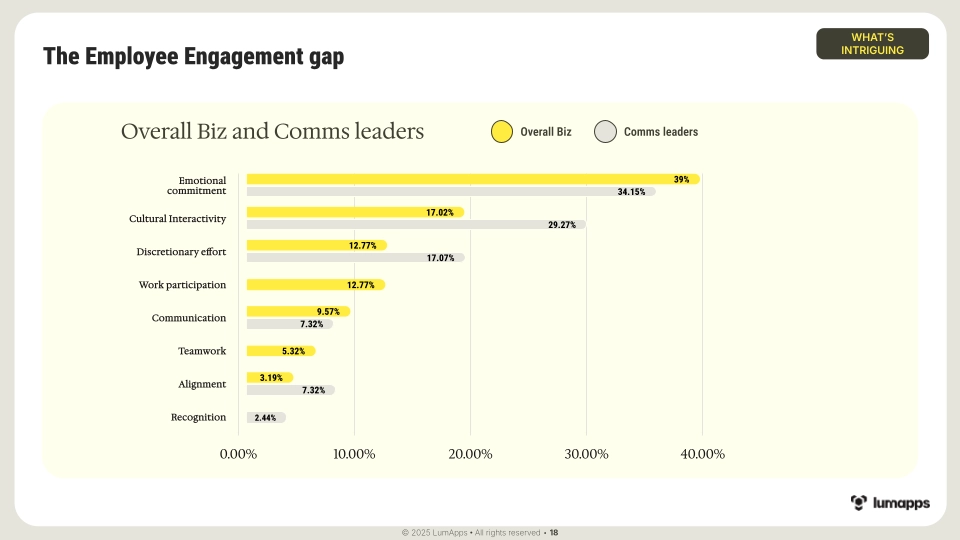
The data backs this up. According to the Future of Work Index, there is a startling lack of alignment on definitions. While some leaders see "emotional commitment" as the goal, others view it strictly as "work participation." This misalignment creates a messy reality where strategies conflict and genuine progress stalls.
If the goal is purely business benefit, employees feel it. They sense when they are viewed as "productivity units" rather than people. And paradoxically, treating engagement as a transaction is the fastest way to kill it.
The Real Driver: It’s About Supporting Employees, Not Extraction
Here is the pivot point for modern organizations. True engagement doesn't start with asking, "What can this employee do for us?" It starts with asking, "How are we supporting this employee?"
Data consistently shows that engagement is a reciprocal relationship. It is measured not by how hard an employee works, but by how supported they feel by the company. When an organization demonstrates that it cares—about an employee's well-being, their career growth, and their daily experience—engagement follows naturally.
It’s a simple equation:
- Old View: Engagement = Maximum output from employee.
- New View: Engagement = Maximum support for employee.
When you flip the script, you stop trying to "make" people engaged. Instead, you create an environment where engagement is the natural outcome of being valued. You provide the right tools to reduce digital friction. You offer clear communication that connects their daily tasks to a bigger purpose. You listen.
How Shared Definitions Lead to Shared Strategy
Cosponsor of the Future of Work Index and #WeLeadComms founder Mike Klein pointed out a critical flaw in how we approach this topic: we project our own values onto the word "engagement."
"Everyone agrees engagement is important, but no one means the same thing," Klein notes. "People project what matters to them so we don’t really know what we’re trying to achieve, and that creates friction from the start."
This is the root cause of so many failed initiatives. If HR thinks engagement means happiness, IT thinks it means adoption of new tools, and the C-suite thinks it means higher profit margins, you have chaos. You have a "Tower of Babel" situation where everyone is working hard, but no one is building the same thing.
Without a shared definition, we cannot have a shared strategy. We launch surveys that measure the wrong things. We implement tools that solve the wrong problems. We waste energy fixing symptoms while the root cause—a fundamental misunderstanding of the goal—remains untouched.
Step One: Align on the "Why" and "What"
So, how do we fix this? We stop guessing and start defining.
Before you launch another internal survey, sit down with your leadership team. Bring HR, Internal Comms, IT, and Executive leadership into the same room. Ask the hard question: What do we actually mean when we say employee engagement?
If the answer leans heavily on "getting more out of people," push back. Challenge the room to look at the inputs, not just the outputs.
Actionable steps to build alignment:
- Define "Engagement" Explicitly: Write it down. Is it emotional commitment? Is it advocacy? Is it satisfaction? Create a definition that includes the employee's perspective, not just the business's.
- Measure Support, Not Just Effort: Stop measuring just productivity metrics. Start measuring sentiment. Do employees feel they have the tools to do their job? Do they feel heard? Do they see a future here?
- Bridge the Gap with Internal Comms: Use your internal communication function as the translator. They are the bridge between the boardroom and the breakroom. Let them guide the narrative away from corporate speak and toward human connection.
Building a Foundation of Support
A shared strategy isn't about squeezing more efficiency out of a hybrid workforce. It’s about building a resilient, connected community.
When you shift your focus from "what we get" to "how we support," you build trust. Trust breeds commitment. And commitment? That is the sturdiest foundation you can build.
Let’s stop projecting what we want engagement to be and start listening to what it actually requires. It requires clarity. It requires alignment. But most of all, it requires caring enough to define it right.