More technology, more friction? The next challenge of digital transformation

We digitized work. Now we need to make it work together.
Over the past two decades, every new workplace challenge seems to have come with a new piece of technology. The result is a workplace that can do more than ever, but also asks employees to navigate more tools, systems and information to get things done.
The Future of Work Index, a LumApps study of 268 business and communications leaders across Europe and the US, looks at how that growing digital environment is experienced at work.
And as the number of tools grows, so do the small frictions that come with navigating between them.
Which raises a question worth asking: after years of investing in technology to make work more efficient, is the next challenge making all that technology work together?
When more tools create more friction
Collaboration, communication, project management, HR, document sharing: the stack kept growing, each time with the promise of making work easier or faster.
Investment followed. 75% of leaders surveyed say their organization invests significantly in technology designed to improve productivity.
At the same time, 56% say their workplace tools are still less effective or intuitive than the technology they use in their personal lives.
And the stack is crowded. 34% of leaders use between six and ten different applications, tools or systems every day.
That means finding a document, remembering where a decision was made, switching systems, logging in again, or simply figuring out where to look for the right information.
A few seconds here, a few minutes there. Repeated throughout the day, these small hurdles add up to digital friction.
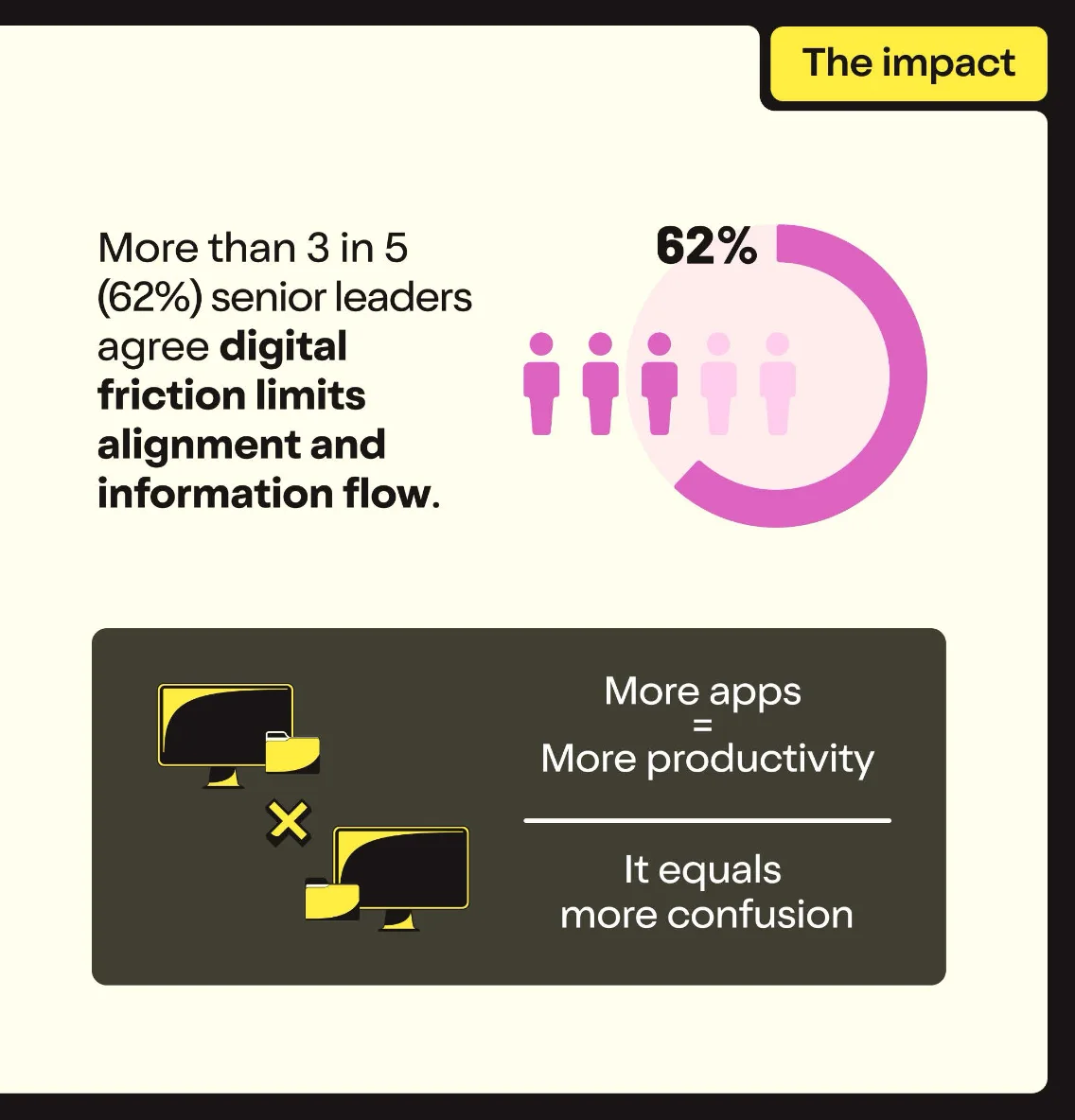
And the impact goes beyond individual productivity: 62% of leaders surveyed say digital friction makes it harder for employees to stay aligned and informed.
Look at the data market by market, and another pattern starts to emerge.
The US moved faster. Friction followed.
The US stands out.
84% of US leaders say the pace of change in their organization has accelerated, compared with 66% in Europe. They are also more likely to invest in the technology designed to support that change: internal messaging tools, employee listening platforms, knowledge-sharing hubs and workplace technology are all more widely adopted in the US.
The US workplace is also an increasingly dense digital environment.
And another number stands out: 28% of US respondents strongly agree that increasing technology friction has made it harder for employees to stay aligned and informed. That compares with 20% in Germany, Spain and Italy, and just 10% in France.
Does faster digital adoption create more friction? The data doesn’t prove it.
But the pattern is hard to ignore. The market with the highest workplace technology adoption is also the one feeling its friction most strongly.
The AI era, repeat or rewrite the story?
AI is the next test.
US organizations are already ahead here too. 42% of US respondents say their organization is actively scaling AI across departments, making the US the most advanced market in the study for AI adoption.
But how is AI entering the workplace? A new assistant here, an agent there, a copilot built into one platform, another interface somewhere else. There’s a real risk of repeating the same cycle, adding more technology to an already crowded environment and losing employees along the way.
There’s another path: using AI to connect what’s already there.
We’re starting to see this happen. Globally, 44% of leaders use AI to support employees through assistants and internal resources, while 37% use agentic AI to automate multi-step workflows.
AI that can find information across systems, trigger an action or complete a workflow reduces the need for employees to jump between tools. It can turn a collection of workplace technologies into an environment that actually works together.
From accumulation to orchestration
The next phase of digital transformation is already taking shape: making all that technology work better together. Connecting tools, making information easier to access, and allowing employees to act across systems without constantly moving between them.
At LumApps, this is the vision behind the AI Employee Hub: an environment where information, applications and AI agents work together around each employee.
We’ve spent years adding technology to the workplace. Now it’s time to make it work together.
Explore the Future of Work Index and discover more insights into the future of work.