How to Write Work Instructions that Reduce Human Error
Research has shown that accidents in the workplace happen more frequently due to errors in systems rather than people. By writing clear work instructions, companies can improve their systems and reduce the number of accidents.

See Beekeeper in Action
Table of contents
- What Are Work Instructions (And How Do They Differ from SOPs)?
- Why You Need Standard Work Instructions
- How to Write Work Instructions
- 5 Best Practices and Strategies for Writing Work Instructions
- Using Work Instructions with Mobile Apps
- Work Instructions Template/Checklist
- Most Frequently Asked Questions
Research has shown that accidents in the workplace happen more frequently due to errors in systems rather than people. By writing clear work instructions, companies can improve their systems and reduce the number of accidents.
Does your company have a crisis communication plan? Download this checklist to prepare your team for an emergency situation.
Trying to solve the “person approach” to human error isn’t as productive as fixing the systems underlying how people approach their jobs. It’s much harder to pinpoint causes of human error like forgetfulness and inattention. By focusing on a more systems-based approach, companies can give employees tools to make better decisions and fewer mistakes.
Improving systems starts with looking at a company’s work instructions and standardized operating procedures (SOPs). Although the terms are often used interchangeably, there are some subtle but significant differences between the two.
In this article, we’ll look at what is an SOP and how it differs from a work instruction. We’ll also offer tips on how to write standard operating procedures and work instructions that improve worker safety and efficiency.
What Are Work Instructions (And How Do They Differ from SOPs)?
Work instructions and standard operating procedures (SOPs) both fall under the umbrella of tools used to make a process more detailed and actionable. Process, procedure, and work instruction build on each other in complexity:
Processes describe what objectives and specifications need to be done. SOP’s describe how a process should be carried out in certain situations. Work instructions describe how each of the steps in an SOP should be carried out.
While a process is a chain of steps, a SOP is a set of mandatory directions for executing those steps. Work instructions detail the correct way to execute those procedures that, if not done properly, would have negative consequences like damage or compliance issues.
Work instructions support the procedures outlined in an SOP, which, in turn, supports a particular process. Not all processes require an SOP and one process could have multiple SOPs.
In general, processes are a summary of what’s needed to complete an activity. SOP’s add more specifics about who should be doing it and what tools they should use. And standardized work instructions are step-by-step guidelines that turn procedures into action plans.
Why You Need Standard Work Instructions
Creating work instructions can get overlooked when processes appear simple, or when there are employees who are able and willing to teach those processes to new hires. Companies may not want to spend the extra effort to create detailed work instructions.
But work instructions create a foundation for processes to continue running smoothly and are vital to a company’s success. Work instructions help:
- Build and preserve a company’s bank of knowledge
- Avoid multiple interpretations of a process and any resulting misunderstandings
- Pinpoint the cause of why a certain process isn’t effective
- Allow companies to keep refining and streamlining their processes
- Reduce risk for processes that may put workers at risk by clarifying the safest way to do their job
- Improve good communication between departments, as creating work instructions is often a collaborative effort
Investing in work instructions pays off in the long run and outweighs the cost of putting worker safety at risk and having to fix mistakes rooted in misunderstandings.
How to Write Work Instructions
Writing work instructions can be daunting when there are multiple, detailed steps that need to be accounted for.
Here’s a suggested process for creating work instructions that are both comprehensive and clear:
- Write the title and introduction: Give a brief background of the context behind a project or SOP and explain the purpose of the job in question. Identify who is responsible for carrying out the processes and give a clear idea of the intended outcome.
- Break down the steps: Describe each step in detail, including all the elements needed to complete the task. Using reference photographs and hyperlinks to other instructions will help reduce ambiguity. Make sure the steps are ordered in a logical order. Additionally, consider employing an AI tool to generate informative visuals, making the instructions even more user-friendly and accessible.
- Verify information: Ideally, work instructions should be written by those who are most knowledgeable and experienced about the process. Even so, multiple perspectives involved in the job will help catch any mistakes or gaps.
- Simplify and format: To make work instructions more readable, simplify and clarify the language to make sure anyone involved in executing them can understand what’s being asked of them. Try to break up the text with images and bullet points to make it easy to scan.
- Consider them working documents: Writing work instructions isn’t a set-it-and-forget-it kind of process. Encourage employees who are using the work instructions and SOP’s to give their feedback and change the documents accordingly.
5 Best Practices and Strategies for Writing Work Instructions
We’ve all read instructions that have made us even more confused than we started. To avoid that, keep these practices in mind when writing standard work instructions:
1. Aim for Clarity
Above all, work instructions should be clear and offer no wiggle room in how a step could be interpreted. Check for statements that are ambiguous or could have more than one meaning. Keep in mind that some employees may have a language barrier to understanding work instructions. So unless you translate documents into multiple languages, keep style and syntax as simple as possible.

2. Make it Accessible
Work instructions should be easily available to the workers who need them, wherever they are. Paper documents that are only accessible in-office don’t do much good for factory workers who are on the job and need to reference them immediately. An app like Beekeeper helps to keep work instructions all in one place, so any employee with a mobile device can access them from anywhere.

3. Check and Update for Consistency
Processes and procedures change over time as systems improve and new technology becomes available. Work instructions aren’t singular documents that exist separately from one another. They’re part of a larger network of interconnected processes. It’s worth updating instructions continuously so that information doesn’t become outdated and cause further confusion.

4. Use a Credible Source
Employees who read work instructions need to feel like they’re written by someone who knows what they’re talking about. Ideally, that someone should have experience carrying out the processes. Or, they could collaborate with someone who does have experience. Consulting an employee, for example, will make sure that the document reflects the reality of how the job is done.

5. Keep it Short and Simple
Technical writing can often get bogged down by jargon and wordy detail. Work instructions that are unnecessarily complex are less likely to get read, understood, used, and updated. Look for ways to make work instructions more concise without sacrificing thoroughness and meaning. If the document gets too long, it might be a sign that you’re describing too many SOP’s and need to break it up into more than one set of work instructions.

Using Work Instructions with Mobile Apps
Work instructions that collect dust in file folders aren’t good for much. At least not to the workers who would benefit from referencing them while on the job. Collecting work instructions on a mobile app makes them more accessible and more useful on a daily basis.
Besides making work instructions more accessible, mobile apps can:
- Gather feedback and data from employees that can be used to improve instructions
- Use messaging to resolve issues as they come up
- Let employees collaborate on documents in real time
- Add visuals to documents and keep them updated with new visuals as they come up
Take a look at what a sample Document Library looks like on Beekeeper.
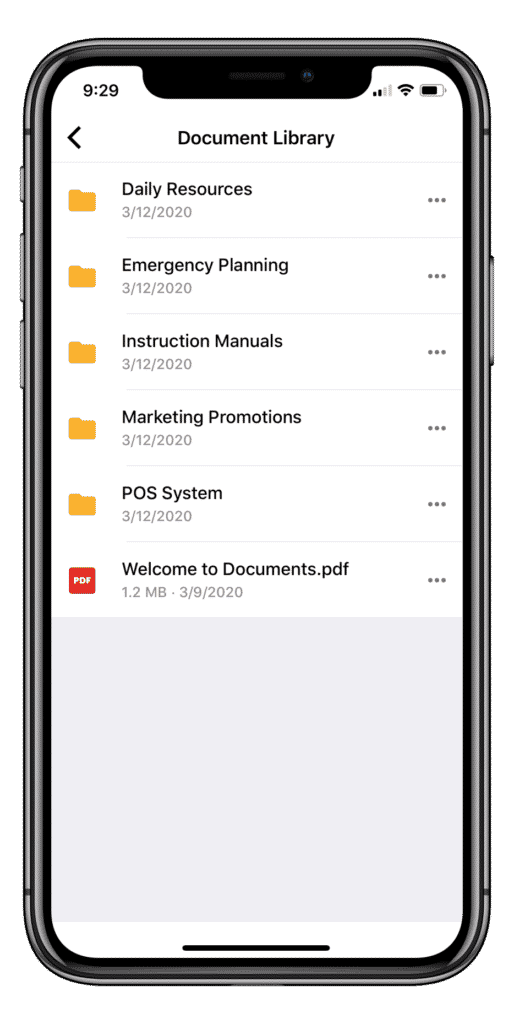
When companies have a lot of work instructions to keep track of, mobile apps can help to keep them organized and targeted towards the right employees.
By using a mobile app to store work instructions, companies can:
- Empower employees to seek answers to questions themselves rather than waiting or relying on management
- Increase the likelihood that employees will reference instructions if they’re easily accessible
- Incorporate employee feedback to make sure instructions stay up-to-date
Work Instructions Template/Checklist
The elements needed for different work instructions will vary based on the job, but there are several things that most work instructions need to have:
- Title and short description of process
- Creator of instruction
- Current version
- Objectives/expected results
- Purpose of task
- Scope/larger context the task is part of
- Tools/skills required
- Safety restrictions/prerequisites
- Step-by-step instructions (with accompanying images)
- Expected results at the end of each step
Most Frequently Asked Questions
How do you make digital work instructions?
Here’s a suggested process for creating work instructions that are both comprehensive and clear:
Write the title and introduction: Give a brief background of the context behind a project or SOP.
Break down the steps: Describe each step in detail, including all the elements needed to complete the task.
Verify information: Ideally, work instructions should be written by those who are most knowledgeable and experienced about the process.
Simplify and format: To make work instructions more readable, simplify and clarify the language.
Consider them working documents: Encourage employees to give their feedback and change the documents accordingly.
What are working instructions?
Work instructions and standard operating procedures (SOPs) both fall under the umbrella of tools used to make a process more detailed and actionable. Process, procedure, and work instruction build on each other in complexity:
Processes describe what objectives and specifications need to be done. SOP’s describe how a process should be carried out in certain situations. Work instructions describe how each of the steps in an SOP should be carried out.
About the author
Top