Top 7 Reasons to Embrace Mobile Communication in Your Company
Mobile communication is an increasingly important part of every business. In the United States, over 81% of the population owns a smartphone . Instead of fighting their overwhelming presence, companies should lean into the trend by embracing mobile communication and harnessing the many uses of mobile phones in business.

Mobile communication is an increasingly important part of every business. In the United States, over 81% of the population owns a smartphone. Instead of fighting their overwhelming presence, companies should lean into the trend by embracing mobile communication and harnessing the many uses of mobile phones in business.
Do you have a BYOD policy in place for your business? Click here to download our free template.
Why Mobile Communication for Business?
Mobile communication has the capability to include every employee for a more robust, well-informed business model. Instead of being out of the loop, both desk-based employees and the mobile workforce can stay in constant communication thanks to wireless networks and mobile platforms.
Traditional forms of business communication, like bulletin boards and snail mail, are finally becoming relics of the past. Today, mobile-first digital communication platforms are becoming mainstream.
Why?
First, more than 80% of the world’s workforce is mobile, frontline workers whose jobs don’t require a desk, computer, or email. Second, the nature of desk-based jobs is changing at warp speed right now.
As the world creeps towards a recovery from the COVID-19 pandemic, companies have reassessed their people operations. Before the crisis ended, companies began opting to allow employees to work remotely indefinitely, and some are even giving up their office spaces.
How Can Mobile Communication Be Used in a Business Setting?
If there’s one word to describe how people communicate around the world it’s mobile. More than five billion people use some kind of mobile device for communicating with each other and for accessing the internet. In the United States alone, people spend an average of three-and-a-half hours every day on their device.

Mobile communication is a natural progression for businesses, too.
Companies can use these numbers to their advantage by adopting mobile-first software to support their workforce. Today, many companies are making the switch from desk-based operational software to cloud-based mobile networks designed to include and support frontline employees.
Here are seven ways mobile communication can benefit a company.
1. Organizational Alignment
When a company forms, they set out a clear mission statement. The key to achieving desired business objectives and securing a market share is to get every staff member aligned to the task at hand. Leaders can use a mobile communication tool to unite their workforce through:
- Value alignment: Leaders should establish a set of core values that every employee agrees to as a member of the organization. These create the ethical guidelines that dictate how an organization should work towards goals.
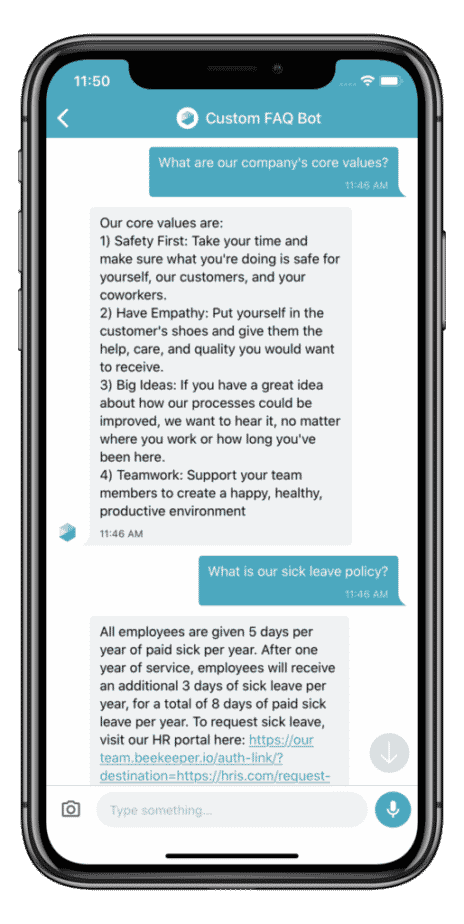
- Cultural alignment: A strong, high-performing culture unifies a workforce through policies that emphasize the employee experience, like employee recognition programs.
- Objective alignment: Mobile communication is a portal for disseminating information, both unique and automated, to ensure everyone is aligned on company goals and objectives.
A mobile communication tool facilitates this multi-tier alignment by:
- Including every employee in the communication network so everyone has the same information
- Creating a channel for two-way communication to get feedback and insight from teams on the frontlines
- Solidifying the manager-worker relationship which 50% of employees say builds trust
2. Improved Efficiency
Mobile solutions can improve efficiency in a variety of ways, but it is especially helpful to mobile workers who spend their time on the sales floor, a job site or simply working remotely.
Mobile solutions increase operational efficiency by:
- Cutting down the need for face-to-face meetings which are often unnecessary and mismanaged
- Creating increased opportunities for management to communicate with staff
- Eliminating data silos for a free flow of information accessible to all workers
- Enabling real-time messaging for faster alignment and decision making. Workers can send and receive communication between colleagues no matter where they are
3. Better Organization
Mobile communication can be used to improve the organization by offering secure file sharing on the go, document collaboration, and many different apps and software that allow employees to access company info anytime.
There are also many additional options, like features that track customers and sales, and project management capabilities that organize tasks and who they are assigned to.
Workers are also suffering from app and information fatigue, burdened by the overwhelming amount of paperwork and software tools it takes to get to the information they need. A mobile collaboration tool creates one hub for integrated systems to consolidate data, documents, and information.
4. Deeper Employee Engagement
Gallup has found that despite the global pandemic, overall employee engagement continues to rise. In fact, at 38%, workforce engagement is higher than it’s been in two decades.
This rise in employee engagement is increasing as companies are forced to make flexible arrangements so their teams can work off-site due to social distancing requirements. The right mobile communication solution can support this new normal in business and strengthen employee engagement by keeping everyone connected no matter where they’re working
Unlike its predecessors, many mobile communication tools can provide leaders with deep analytics to gauge the wellbeing of their workforce, find weak spots within their management sphere, and make data-driven decisions to increase engagement.
5. Increased Productivity
There are several ways mobile communication can increase productivity, including many of the reasons listed above. An additional benefit of mobile communication is improved productivity for a mobile workforce that doesn’t work in a cubicle.
With mobile solutions, managers can capture the wisdom of their operations staff and apply it to an entire division or department. The employees in the action are most intimate with the challenges their company faces. An enterprise messaging app allows management to capture this valuable intelligence.

6. Mobile Communication Facilitates Greater Collaboration
Collaboration is what can push a company ahead of its competitors. Creating a workplace that is built on a diversity of ideas from every level drives innovation.
Computer-based workforce software has its limits. Primarily, it’s only accessible to desk-based workers. But mobile communication extends that reach to teams who are mobile or remote, particularly customer-facing workers who can provide their colleagues with valuable insight into how their products or services are being received.
The benefits of mobile devices in business and enterprise-wide collaboration capabilities include:
- Employees from different departments and at different levels have a space to work together which increases productivity
- Increased collaboration drives innovation which can increase a company’s value proposition
- The more minds that are involved leads to faster, more creative problem solving
- Better cross-functional team alignment
Again, as we’re seeing now, companies have had to take collaboration from conference rooms to the cloud in recent months. Mobile communication makes this a seamless transition for companies.
7. Greater Autonomy and Empowered Workers
A mobile communication tool at the tip of their fingertips gives workers a greater sense of belonging within the company. It also empowers them with features that allow them to be more autonomous.
A few examples include:
- They have the power to initiate communication through a flattened hierarchy.
- They can manage their own schedules.
- They have the power to provide feedback through surveys and messaging that can benefit the company.
- They have access to professional development opportunities over their mobile devices.
While there are many benefits to mobile communication, it’s important to keep in mind that there is always a security risk when using it. That’s why it is so crucial to choose business-specific, secure, qualified platforms, and systems.
The right mobile solutions will only help your business by allowing your company to take advantage of all the benefits of mobile-first communication for your company and your workforce.
Most Frequently Asked Questions
Why are mobile systems so important to businesses?
Mobile communication has the capability to include every employee for a more robust, well-informed business model. Instead of being out of the loop, both desk-based employees and the mobile workforce can stay in constant communication thanks to wireless networks and mobile platforms. Traditional forms of business communication, like bulletin boards and snail mail, are finally becoming relics of the past. Today, mobile-first digital communication platforms are becoming mainstream.
About the author
Top