FFOW Part 5: Understanding The Complete Process of Frontline Digitization
Welcome to our fifth and final post in our Frontline Future of Work blog series! If you haven’t had a chance to read the full series yet, you can get caught up with the first four articles below:

Welcome to our fifth and final post in our Frontline Future of Work blog series! If you haven’t had a chance to read the full series yet, you can get caught up with the first four articles below:
Throughout this series, we’ve taken a deep dive into who frontline workers are, what they need to be successful, and how businesses can digitally enable them to excel in their roles. In this final piece, we’ll take an in-depth look at the nitty-gritty details behind the process of digitization for frontline workers.
How exactly do you take your organization from communicating through printed memos, bulletin boards, and chaotic WhatsApp groups to streamlined, fully digitized, operational communication?
We’ll take you through the entire process, step by step.
The Four Stages of Frontline Worker Digitization
In our experience, this process of digitizing your frontline workforce happens in four distinct stages. Different companies and industries are at different stages.
Usually, we can easily determine which stage a company is in. It’s also not unusual to observe different stages within the same company or group, where buckets of employees jump ahead one or two stages on their own, paving the way for the rest of the organization.
Let’s dive into the four stages of digital enablement:
1) The Status Quo: Traditional, Top-Down Internal Communication
The first stage of digital enablement is where many organizations still find themselves to this very day. They likely have a robust tech stack of tools for their office workers to collaborate with.
Typically these office workers will work on presentations, documents, spreadsheets, and information that needs to be shared with the rest of the organization to take action through different digital channels like email, intranets, or company-wide presentations.
But when it comes to reaching their frontline, organizations at this stage are still heavily reliant on paper-based, unscalable solutions. The primary channels to relay relevant information, plans, work orders, and drive the business forward are centered around unreliable, untraceable methods like printouts on bulletin boards and leaning on frontline managers to orally convey information to their teams.
The most common traditional communication channels we see companies using include:
- Bulletin boards
- Notes attached to paystubs
- Printed employee newsletters
- Word of mouth
- In-person meetings
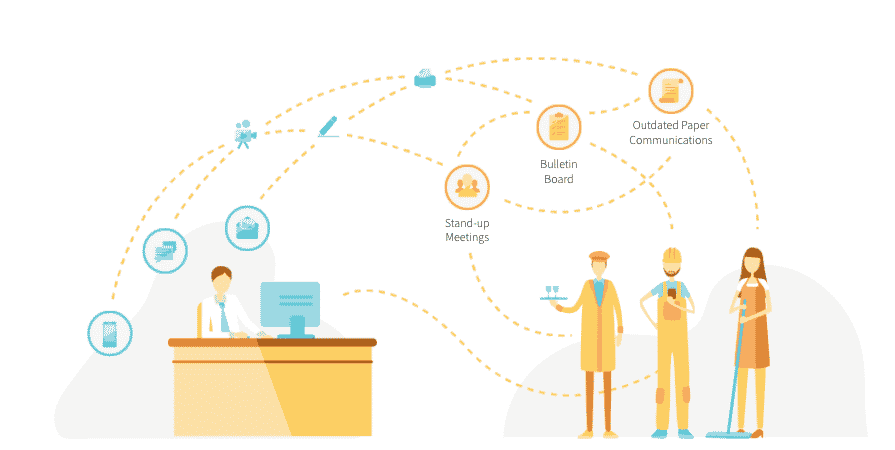
There are a few problems with these top-down, cascading communication channels:
- Managers spend up to 60% of their time relaying information
- Frontline workers spend up to 3 hours every week looking for information
- The feedback loop from the frontline workers to the corporate headquarters is cumbersome. It’s also highly inefficient and does not allow senior leadership to gain insights into the effectiveness and impact of their initiatives
Understandably, both frontline workers and managers are always looking for new ways to make their lives easier and streamline communication.
When left to fend for themselves, many frontline teams and managers rely on consumer chatting apps like text messaging or WhatsApp for workforce coordination.
But, the proliferation of consumer-grade workplace collaboration platforms can be extremely problematic for the organization (especially IT). This is because these platforms come with significant operational and IT security risks that could pose a threat to your organization.
2. The First Light Bulb Goes On: Making the Decision to Digitize

This year, the coronavirus accelerated the digitization of the frontline workforce. The sudden, urgent need to keep pace with the rapidly changing updates brought on by a global pandemic prompted organizations to fast-track their digitization efforts.
As the international spotlight on the importance of our global frontline workforce grew brighter, the need to properly equip these mission-critical workers grew more urgent by the day.
Making the decision to digitize was an important step we saw many companies take this year.
Shaking Up the Status Quo
The first step in changing the status quo is always driven by brave and innovative leaders. Shaking up the status quo and making a commitment to do things differently is just the first step in your organization’s journey towards digitization.
In our experience, senior leadership, HR, and Operations teams are among the first leaders in an organization to realize there is a better way to reach their frontline teams. Why them? Because they deal most directly with the barriers of communicating with frontline employees.
Those closest to the problem are often also those who are closest to the solution.
In order to drive change, these brave leaders embark on the daunting task of changing the mindset around collaboration within their organizations. Championing organizational change within an established organization is never easy, but John Baldino, 2020 HR Consultant of the Year and President of Humareso suggests that involving HR early on in the process is vital.
When HR is involved in change management within an organization, it must be both overarching to the entire company, but also specific to each contributor. That’s why collaboration serves as a viable tool. Bring together those who can identify an area for improvement along with ideating for solutions. HR can foster such a dynamic."
- John Baldino, President of Humareso
Common Digitization Workarounds
Initially, to solve the problem of the disconnected workforce, many organizations try to extend existing collaboration systems to their frontline employees.
Some of the workaround approaches we have seen across geographies and industries include:
- The Email Approach: Companies creating an alternate email domain for frontline employees in order to give them login access via SSO to the rest of the IT landscape. A great example of this is the bundles offered by Microsoft as the F1 license.
Typical outcome: Employees struggle to keep up with password policies, and activation of accounts and are lost in the complexity of a tech stack with too many apps. This confusion creates more work for IT teams as they scramble to support a team that is trying to use a technology that wasn’t built for them.
- The Intranet Approach: Intranets are a tried and true (albeit old school) internal communication channel. For the most part, they already contain documents, materials, and knowledge your team needs. Why not extend this to your frontline workers? Well, when was the last time you visited and enjoyed your company intranet?
Typical outcome: Intranets are not built for a mobile, dispersed workforce. Therefore adoption rates among frontline workers is notoriously low and engagement is almost nonexistent.
- The Social Intranet or Network Approach: If the company already uses a social network like Yammer, Jive, or another “social networking-style tool,” why not try to bring your frontline workers on board? Typically social intranets or networks work great to promote more organic collaboration within the company. But, these options are quite far removed from what frontline workers really need in a tool.
Typical outcome: Chaotic and difficult to manage, social networks often end up wasting more of your employees’ time in the long run.
- The Employee Magazine Approach: this is one of the most common ways to inform frontline employees about non-operational topics. Why not digitize it? You save paper, printing, and distribution costs!
Typical outcome: While digitizing your employee newsletter can be a great first step in the process, they are still expensive and time-consuming to produce. And they don’t deliver information in real-time, which is what your frontline workers really need.
While these are all admirable attempts toward digitizing the frontline, they often fall short of delivering true business value that impacts the core of the organization.
So then the question remains: How do we truly empower the frontline workers with information, tools and materials that they need every day, all day to do their job and contribute to the success of the business?
The proliferation of employee apps, “improved” intranet software, clunky product bundles, and social intranets have generated a lot of buzz — and more often than not — more noise in the space, which can certainly be confusing for proactive leaders searching for solutions.
3. The Rise of Operational Communication for the Frontlines

When you take a hard look at the root causes and problems we are trying to solve, you ultimately end up focusing on two core objectives:
- How to drive business value and support the business
- Fulfill core needs of the end-users, (i.e. frontline workers)
Note that so far, in the first two stages, very little to no thought has been given to the question “What do frontline workers really need to be efficient and excel at what they do?” An Office F1 license, a sophisticated intranet software, or a social network cannot be the answer.
The initial steps taken by organizations reveal many of the hurdles that come with deploying technology to the frontline workers.
The bottom line is that we are entering a fundamentally different domain, playing an entirely new game with different rules than the ones which govern technology for desktop workers. We must have a unique strategy when it comes to technology for the frontlines.
At a time when frontline workers are under more stress, pressure, and hardships than ever, they need clear, customized solutions that make their daily lives easier.
In this stage, companies and business leaders begin to realize that the solution for reaching their frontline workers goes beyond HR, and Internal Communication and must involve other functions and departments in order to truly make a difference. The conversation then starts to shift to business processes and how to support, simplify, and accelerate them. Throughout this process, we see other business functions like Operations, Health and Safety, and IT join the discussions much more proactively.
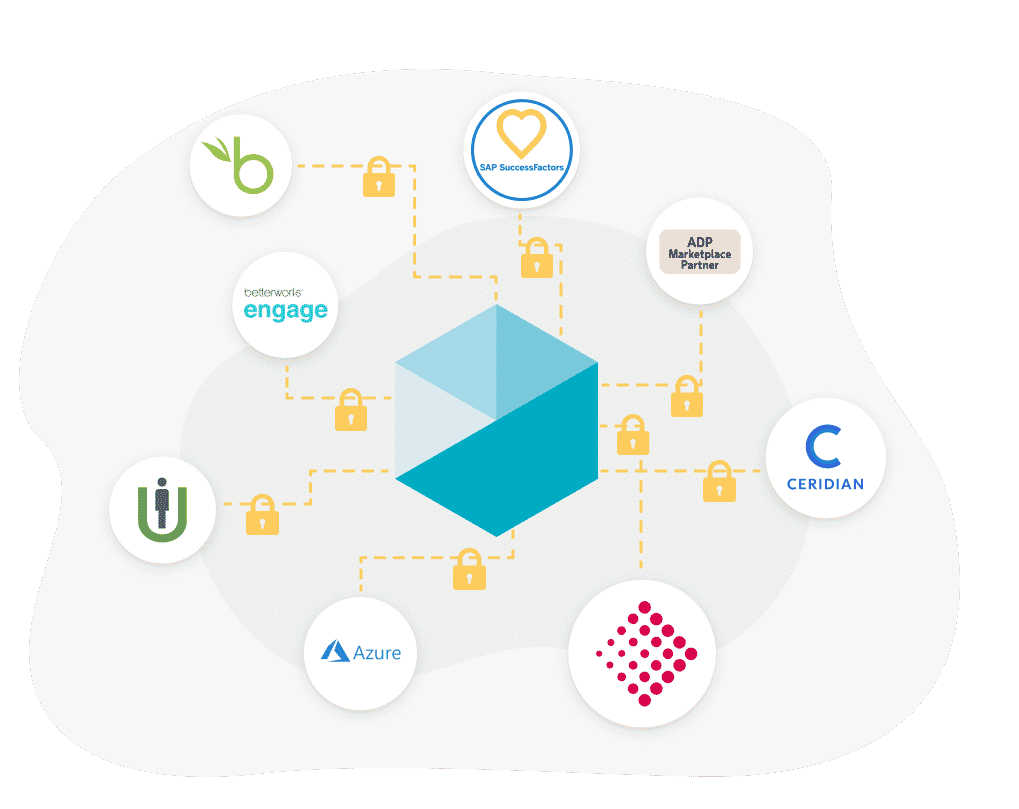
The big question is, “If I already have so many systems, and processes: How do I leverage this and expose them to the frontline without overwhelming them?”
The answer? Keep your solution extremely simple and streamlined for the frontlines. This means that you should look for a tool that is user friendly, and has virtually no learning curve. Ensure that anyone on your team can pick it up and use it within minutes with little to no training required. This will ensure high adoption rates while maximizing value.
At the same time, you can leverage the complexity and power of integration workflows on the back-end to offer a truly streamlined employee experience that supports the core needs of the business.
4. The Journey of the Connected Worker: Digital Transformation

As with any transformation in history, the journey towards digital transformation is a marathon, not a sprint. But it all starts with a single step. The larger vision and long-term benefits one aims to achieve with a connected workforce need to be clear to business leaders and the broader organization as a whole.
McKinsey estimates that digital collaboration has the potential to unlock more than $100 billion in value — thanks in part to productivity boosts of 20 to 30% in collaboration-intensive work processes such as root cause investigation, supplier management, and maintenance.
It’s a good idea to start with a list of potential business processes you want to optimize, then prioritize and build a framework to put it into action. Having a clear plan will be key to the success of your digitization program. Strong technology partners can be a great way to accelerate this process.
COVID-19 was an extreme catalyst of rapid digitization that catapulted many companies into this stage as they were forced to overcome the numerous operational and safety challenges of running a business in the midst of a global pandemic.
These challenges included:
- Keeping furloughed employees connected and informed on job status, resources, and more
- Onboard and train new employees in a shorter period of time
- Stagger breaks and shifts to ensure social distancing guidelines
- Train employees on updated safety protocols and procedures around cleaning, wearing masks and interacting with customers
- Overcoming disruptions to the global supply chain and pivoting business operations as needed
In this fourth and final stage of digitization, businesses examine their core business processes and determine how to make them more resilient and agile in order to accommodate operational curveballs and sudden, unexpected changes. They then learn to leverage their resources on-demand and as needed. This in turn, decreases overhead and operating expenses while empowering frontline employees to make faster, better decisions.
My Frontline Workforce Is Connected. Now What?
Once your organization has made the decision to invest in digitization and building a connected workforce, what are the next steps? We’re so glad you asked.
At Beekeeper, we’ve identified four steps companies must take in creating a digitally enabled workplace of the future:
- Adopt a digital channel to reach and connect the entire front line
- Digitize time-consuming, inefficient, expensive paper-based processes
- Establish an automation strategy that harnesses the full knowledge and power of the frontline workforce
- Optimize organizational processes with data-driven insights

Creating a digitally connected workforce — from factory workers to retail associates — will be crucial in completing the digital transformation process. Digital workplace tools will remain vital in driving productivity, operating more efficiently, and complying with evolving health and safety regulations.
The digital revolution for frontline workers is here.
How will your business evolve, adapt, and change your core strategies to stay competitive in a post-COVID economic landscape? The frontline future of work is now. It’s time to enable and empower our frontline employees around the world.
Will you join us?
Want to build the frontline workforce of the future? Download our Frontline Future of Work eBook.
About the author
Top