What Is Lean Manufacturing? Top Tips for Cutting Costs
This concept and practice of lean manufacturing has been around for nearly a century. But in the age of Industry 4.0, technology has created a prime opportunity for companies to streamline processes, reduce operating overhead , and move into this next industrial revolution with a lean manufacturing approach.

Lean manufacturing is a growing trend in the industrial world. As markets change and competition escalates, companies are looking for ways to cut costs, boost productivity, and run more efficiently.
This concept and practice of lean manufacturing has been around for nearly a century. But in the age of Industry 4.0, technology has created a prime opportunity for companies to streamline processes, reduce operating overhead, and move into this next industrial revolution with a lean manufacturing approach.
Discover top lean manufacturing trends. Download our free white paper here.
What Is Lean Manufacturing?
If you perform a Google search for a lean manufacturing definition, you’ll find a few different ways it’s explained. But to sum it up, lean manufacturing is operating with minimal waste.
Now, let’s expand on that. Sometimes called lean operations, lean manufacturing is continually assessing and improving the various parts of your organization to reduce waste and keep costs down while boosting productivity, quality, and innovation. From people and machines to process and systems, lean manufacturing encompasses every aspect of an operation.

Lean manufacturing is keeping operational elements that add value and eliminating ones that don’t.
Waste is anything that does not add value and takes away from profit potential. Waste can negatively affect your entire manufacturing operation and can result from:
- Excess inventory
- Overproduction
- Excess energy and movement
- Equipment failures or downtime
- Weak supply chain infrastructure
- Poor communication channels
- Misplaced human potential
The ultimate goal of lean manufacturing is to deliver high-quality goods for a lower operating cost. This is achieved by improving processes, engaging people, and streamlining communication so everyone is aligned and working toward achieving the same goals to increase your company’s value proposition.
In order to compete in today’s world and survive the unpredictable nature of the global economy, a company must be agile, able to flex but not break. The way to achieve this is to adopt lean manufacturing principles.
At Toyota Lean Manufacturing Is Born
While the term “lean” came about in the 1980s, the genesis of lean manufacturing happened much earlier. In 1934, Kiichiro Toyoda, founder of the Toyota Motor Corporation, decided his company would build its own engines. After casting, machining, and building 300 engines, his team quickly realized a defect in the design and had to scrap the batch.
Unhappy with the waste, Toyoda created a flow process where workers stopped and inspected pieces as they moved through their build in order to create a continuous flow. Stopping production to fix a part resulted in the ability to both remove a defect before it was completed and to improve a step in the production process. This repetition results in continuous improvements in production and quality.
The Toyota Production System, or TPS, bases its operational approach on two concepts:
- Jidoka is the automation of processes that safely come to a halt when an abnormality occurs during production. A balance between machine power and human ingenuity, jidoka allows a manufacturer to fine tune specific steps in their operation as problems arise. This is known as kaizen, a philosophy of continuous improvement that is the foundation of lean manufacturing.
- Just-in-time bases manufacturing on customer demand. Instead of mass-producing cars, Toyota builds based on orders. This eliminates overproduction, material waste, and inventory storage. With a just-in-time approach, manufacturers know exactly what and how many parts to stock. It also allows employees to work on a specific number of products which limits the production quota.
Today, companies around the world base their lean manufacturing strategies on these core philosophies and Kiichiro Toyoda’s view that “the ideal conditions for making things are created when machines, facilities, and people work together to add value without generating any waste.”
Kickoff Your Lean Manufacturing Strategy With Your Workers
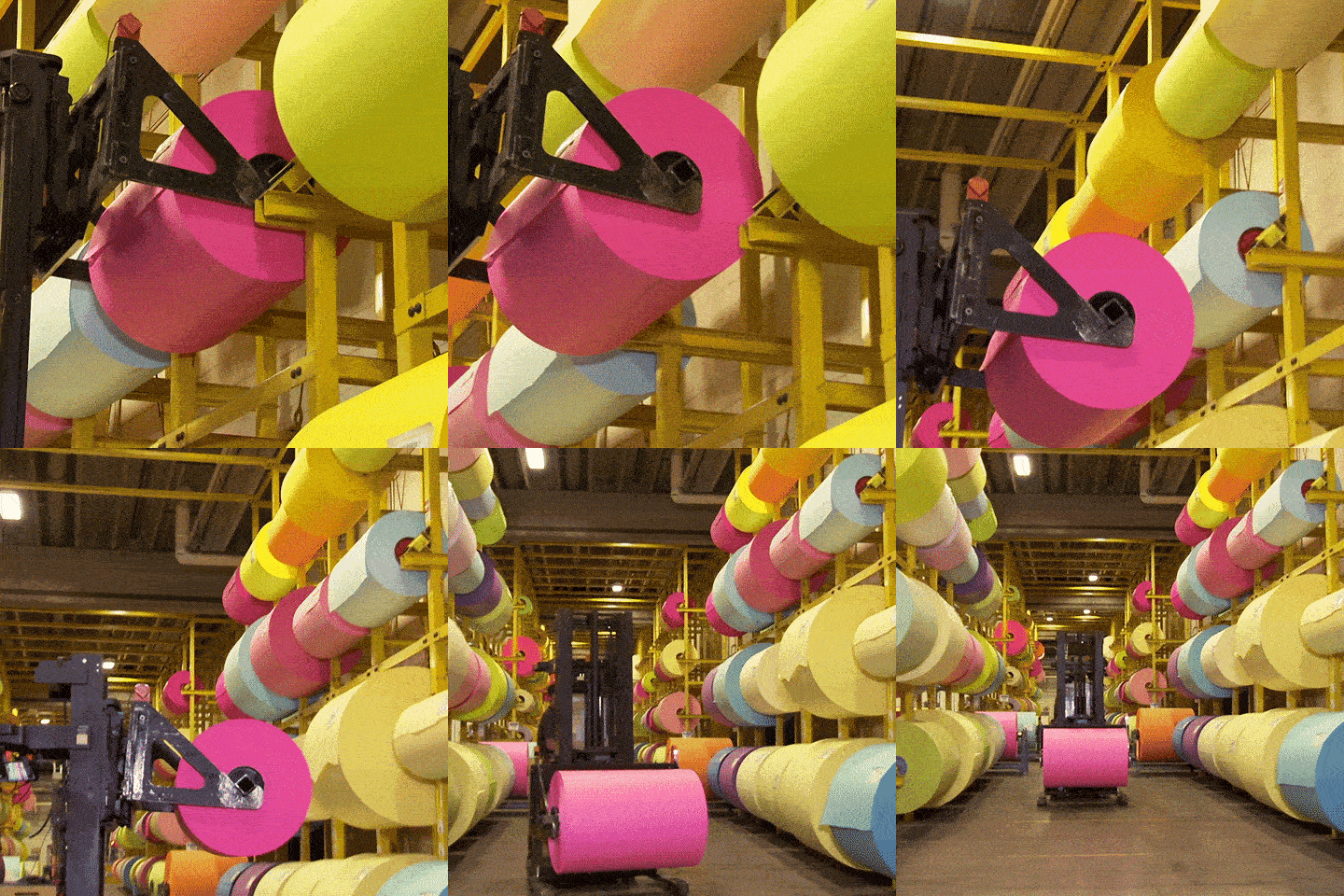
The first image that comes to mind when people think of manufacturing is heavy machinery. But the industry really relies on a huge frontline workforce. This presents a massive communication challenge, as mobile workers often don’t have company email, they can be a hard-to-reach group.
Communication with frontline teams often relies on in-person meetings or notes tacked up on a bulletin board. Fractured communication with the people running the production lines in a time-sensitive industry is ripe with opportunities for waste. And it’s the reason companies should start their lean manufacturing strategy by strengthening their workforce.
Here are some tips to make your workforce as efficient as possible:
- Maximize every worker’s potential by matching their strengths to the best position for them.
- Use mobile communication tools to invest in job training programs. This creates opportunities for your workers to grow and build up their strengths for both their personal gain and to create greater value in your operation. You’ll have a more engaged workforce and boost productivity.
- Give frontline workers mobile communication tools to connect with the company. They often spend over three hours a week just searching for information. A mobile collaboration platform can eliminate that wasted time and energy by giving them access to all of the information they need to perform their jobs.
The 5 Principles of Lean Manufacturing
There are five guiding principles of lean manufacturing that can help companies as they transition to a new way of operating.
- Identify the value for your customer. The process of going lean begins at the end of the production cycle—with your customer. Determine the value of your product by what your customer needs and demands.
- Map out the value stream. Using the calculated value, the next mission is to map out your value stream, or the process that will take your product from raw material to the finished product. Eliminate any steps that don’t add value. Some companies visually track this journey with a kanban board which helps identify areas or steps in the process that produce excess waste.
- Create seamless workflows. With your operation mapped out, it is easier to examine and analyze each step. Find and close up gaps to create a continuous flow. This is an area where companies can also manage personnel and see where each worker adds value and position them accordingly.
- Switch to a pull-based production schedule. Based on Toyota’s just-in-time concept, a pull-based production means putting only the ordered number of goods into production. This allows teams to work on specific orders for higher quality results. It also reduces inventory waste since companies stock only what they need.
- Repeat the process. Lean manufacturing is more than a one-time optimization strategy. It is an iterative process of assessing and optimizing workflows. It is a philosophy that should be rooted in your company culture, communicated to every worker, and be the foundation for your operation.
8 Benefits of Lean Manufacturing

Manufacturing companies rely on a complex set of systems, equipment, and people working in unison. When any, or all, of these elements are inefficient, a company produces waste which can lead to cost overruns, sluggish operations, and a disengaged workforce. From the raw materials to the finished product, lean manufacturing optimizes every touchpoint of the production cycle for enterprise-wide efficiency that has a positive impact on the company.
Some of the most important benefits of following the principles of lean manufacturing include:
- Improve quality of goods
- Reduce waste
- Create seamless workflows
- Reduce costs
- Increase profits
- Increase business agility
- Increase innovation
- Improves customer service
Two Lean Manufacturing Examples
Lean manufacturing can take many different approaches and will produce different results for different companies. Here are two examples of how companies have improved processes and reduced wasteful spending through lean techniques.
- AGCO: As the world’s largest manufacturer of agricultural equipment, AGCO keeps up with the evolving farming industry and adjusts their operation accordingly. The company dedicates a lean approach to its people, processes, and systems to ensure efficiency all around. With nearly 21,000 employees worldwide working for several brands under their banner, AGCO decided to centralize communications through a digital platform. This enabled greater collaboration and innovation, and reduced expenses by $45,000 a month.
- Holcim. Holcim is one of the top producers of building materials, such as cement, aggregates and ready-mix concrete. When the company’s Italy and Switzerland locations needed to improve operational communication, they switched to a mobile platform to align 1,500 employees. The real-time communication capability supports continuous workflows across numerous locations. It also created a digital home for the company’s employee magazine, eliminating paper waste and saving the company $50,000 a year.
Top 4 Lean Manufacturing Best Practices
Here are four of the most effective ways to incorporate lean thinking into your manufacturing operations:
1. Automate As Much As You Can
Manufacturing operations rely heavily on machinery. Thanks to the Fourth Industrial Revolution happening now, new equipment is constantly evolving to optimize processes and workflows. Hop on that bandwagon and automate wherever you can. This will reduce human error that can result in product recalls. Today’s smart machines also have predictive maintenance capabilities that allow them to send alerts when they sense an inconsistency, an ability that falls under the jidoka philosophy of lean manufacturing.
Equipment failures account for a huge amount of downtime and money in a production facility, with costs that can run near $260,000 an hour.
Time consuming administrative tasks can also be automated. For example, onboarding new workers is a long and laborious process that takes up valuable time. By digitizing employee paperwork, new hires can fill out and save documents to the company server on their own, allowing HR to focus on value-adding tasks like talent acquisition.
2. Streamline Communication
Miscommunication is an easy fix, but it is so often overlooked as an essential part of lean operations. When communication channels are ineffective, it impacts a company’s ability to support collaboration and solve problems. It also can waste a ton of money. For large companies, poor communication can cost more than $62 million a year. For smaller companies that number is $460,000 every year. That money could be spent on value-add initiatives like collaboration tools and automation.

Using a lean manufacturing tools, like mobile communication software, can:
- Align an entire manufacturing workforce to goals and schedules
- Speed up workflows by reducing time between shift worker knowledge transfer
- Enable collaboration between frontline workers
- Allow workers to connect with smart equipment to supervise workflows digitally
3. Scrap Batch Production in Favor of Just-in-time Manufacturing
Many companies manufacture products without regard to actual customer demand. Start by looking at actual numbers that customers order. Then, put only that amount into the production line. You’ll eliminate waste in ways like:
- Saving on storage space and costs by not having to store a surplus of raw materials
- Saving on labor costs by paying employees to work on projects that are covered by the customer
- Having only products made that are actually needed instead of a surplus of goods that may not find a home and might eventually be discarded
4. Continuous Improvement
At its core, lean manufacturing is based on kaizen—a philosophy of continuous improvement. When you make an improvement in one place, look for the next part of your operation that can be optimized for greater efficiency. Use failures as opportunities for learning and growth. Make lean a part of your company’s core values that are shared with everyone. For lean manufacturing to really work, everyone needs to share the responsibility of improving systems and processes. Employees should be empowered with the encouragement and tools to report areas of improvement that they find in the course of their work.
About the author
Top