How to Master the Art of Business Communication: A Complete Guide
A solid relationship depends on good communication, especially in business. And, effective business communication matters now more than ever.

A solid relationship depends on good communication, especially in business. And, effective business communication matters now more than ever.
Learn how to connect with your entire workforce with our ultimate internal communications toolkit.
What Is Communication and Why It Is Important?

Business communication is at the core of everything we do in the workplace. It’s how we interact with colleagues and customers to meet business objectives.
Before digging into the details, let’s review the essentials: What is communication and why it is important?
What Is Communication?
The Business Dictionary defines communication as:
Two-way process of reaching mutual understanding, in which participants not only exchange (encode-decode) information, news, ideas, and feelings but also create and share meaning. In general, communication is a means of connecting people or places.”
It defines communication in business as:
The sharing of information between people within an enterprise that is performed for the commercial benefit of the organization. In addition, business communication can also refer to how a company shares information to promote its product or services to potential consumers.”
In the workplace, communication exchanges include:
- Face-to-face interactions
- Written communications, like memos and posters
- Digital channels, like email and instant message
- Business communication apps, like Beekeeper
What Is The Communication Process in Business?
So, what is the communication process in business? Here are the eight common steps for any communication exchange.

- Sender: The sender is the individual that sends a message, initiating the process of communication.
- Message: The message is the information generated by the sender to the receiver.
- Encoding: The stage of encoding is selecting the symbols or words within the message. The intended message can be either verbal, written, or non-verbal (i.e., body language).
- Channel: The channel, or medium, is how you will distribute the encoded message. If the message is written, will it be delivered on paper or through digital verticals?
- Receiver: The sender’s message reaches the intended receiver.
- Decoding: The stage of decoding is where the receiver converts and interprets the message.
- Feedback: Once the message has reached the receiver and the receiver has decoded its contents, the receiver can reply. This is the feedback loop that signals to the sender that their message was received and understood.
- Noise: Noise is any interference with the message that could interrupt the successful communication exchange between the sender and receiver.
What Are The 6 Types of Communication Problems Effective Business Communication Can Solve?

Every business grapples with communication challenges. In fact, some of the largest organizations in the world, like Nike, Starbucks, and Wells Fargo, have suffered significant business communication failures that we should all learn from.
Let’s look at what are the 6 types of communication problems effective business communication can help solve.
1. Failing to Empower Employees With Information
Employee empowerment is a critical workplace practice that many businesses still lack.
When companies don’t empower their workforce with the information they need to do their jobs effectively, their workforce suffers from:
- Decreasing morale and motivation
- Low job performance and quality of work
- Unhappiness in the workplace, which leads to high turnover
A recent Harvard Business Review report found:
- 87% of respondents thought their business would be more successful when frontline employees are empowered to make decisions
- 72% saw an increase in productivity by empowering frontline workers
2. Using A Top-Down vs. Bottom-Up Communication Structure
Traditional top-down communication can occasionally hit roadblocks, especially when the message isn’t communicated through the right channel.
For example, a frontline worker in an automotive factory that doesn’t have a company email address missed the CEO’s company-wide email discussing performance progress. The progress that employees helped achieve.
Additionally, top-down communication puts the responsibility solely on the supervisor to communicate critical information. This could result in information not being relayed to the frontline employees of the company.
3. Neglecting Established Feedback Channels
Everyone wants to have their voice heard, right? Which is why it’s imperative for businesses to give employees the opportunity to speak up.
When employees feel empowered to provide suggestions, they feel valued.
Also, businesses that neglect to seek out feedback from their employees miss the mark to better understand where they can improve.
4. Not Striking The Right Communication Balance
You may have heard of office employees complaining about information overload. This is usually because some groups have too many communication channels, and it can be a lot to keep up with.
Other cohorts like frontline employees oftentimes don’t have access to enough information.
These employees are sometimes not included in important updates or rely on static communication channels, like break room bulletin boards and posters.
Selecting a centralized communication channel that meets the needs of your entire workforce is key.
5. Forgetting About Inclusivity
Did you know that 90% of organizations struggle with language barriers in their day-to-day work?
Globalization has made the world smaller (in a good way), and with it, companies are building multicultural workforces that communicate in various languages.
But when it comes to company communications and information, businesses have typically gone one of two ways:
- Hiring translators and individually translating messages, which takes time and money
- Leaving out employees who speak a different language altogether
Neither of these approaches is sustainable for the long-term health of the business. Many companies that want to reach all their employees all the time are using business communication apps equipped with inline translations.
6. Using The Wrong Tool
With all the communication tools at our fingertips, it’s difficult to know which one is best. In our experience, companies that don’t account for all of their employee groups often adopt the wrong tools.
For example, static company intranets may be useful for office employees, but they’re hard to engage with on the mobile devices most frontline employees use. A deep reliance on company email for business communication leaves out employees who don’t have an assigned email address.
The Importance of Communication Through Business Communication Apps

The importance of communication through the right channel should be at the forefront of every company executive’s mind.
For the frontline, mobile business communication apps are often the most effective way to reach their teams.
A recent CareerBuilder survey found:
- 80% of workers keep a smartphone in view throughout the workday
- 2 out of 3 workers acknowledge that they use it at least several times throughout the day
5 Benefits of Mobile Business Communication Apps
In addition to solving common business challenges, mobile communication apps also deliver real business benefits. Here are just a few.
1. Boost Employee Engagement and Retention
According to a long-running Gallup poll on employee engagement, only 35% of employees feel engaged in their job.
Building relationships with your team through business communication apps can significantly impact employee engagement because it’s visible and accessible to everyone, no matter where they work.
When your staff feels more consistently connected and included employee engagement increases. This creates a positive ripple effect throughout the company.
Employee satisfaction affects your core business areas that impact success such as:
- Morale
- Retention
- Productivity
- The bottom line
The best way to motivate your team and keep employees engaged is to embrace improving your business’s communication side.
2. Real-Time Messaging with Data Security
Some messages are time-sensitive and need to reach every employee quickly. In industries with a majority of frontline workers, that creates an internal communications hurdle.
With a mobile employee app, your business communication is front and center with real-time information for your entire staff.
For example, in a retail environment, a frontline team can message a purchasing manager when certain items need to be reordered. The purchasing manager receives the message on their mobile device, communicates with the storage warehouse, and can quickly place the order.
Digitizing the exchange of information means that decisions can be made faster because direct collaboration saves time.
3. Build an Energized and Cohesive Team
The right business communication tools not only create a dialogue between the C-Suite and their staff, it also facilitates peer-to-peer communication.
Creating a lateral network unifies an otherwise disconnected workforce. A unified workforce means a more efficient, productive team.
Fairmont, Raffles, and Swissôtel have 50,000 employees across 120 properties worldwide. With Beekeeper as their business communication tool, they’ve connected a dispersed mobile workforce to management and to one another.
Having consistent, real-time communication has created camaraderie and built strong teams who are all working towards the same goal. Employees can create posts and ‘like’ or comment on a colleague’s post throughout their shift to:
- Stay updated on important information
- Communicate with each other
- Be better informed about any workplace events, changes, and activities
4. Give Frontline Workers a Voice with an Employee Feedback Tool
Providing employees with an ongoing opportunity to share their experiences and thoughts on the workplace is vital for successful business communication.
A two-way dialogue, rather than solely top-down communication, goes a long way in strengthening employee engagement by building trust.
With a team app or business communication software, management can create surveys to keep their pulse on employee satisfaction. More regularly, sharing this invaluable feedback encourages employees to express where a company is doing well, and where there’s room for improvement.
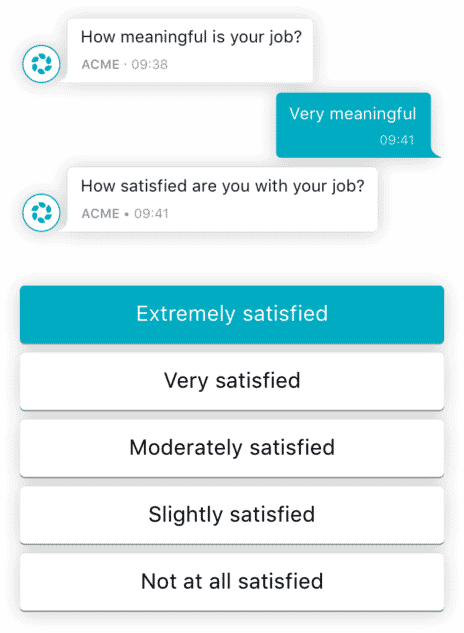
When employees feel heard and valued, they become more invested stakeholders in the company.
5. Empower Brand Representatives
As the primary point of contact with your customers, frontline teams are your brand representatives.
How they perform and the experience they provide for customers is directly linked to the information and resources they receive. When the employee experience is suffering, employees feel disconnected and uninformed.
At best, lack of communication and information can lead to “I don’t know” responses. At worst, this can negatively affect the service they provide as a result.
A business communication app can address this issue by empowering employees with the resources and knowledge they need to best perform their jobs.
A digital tool allows for crucial information about company history, mission, and any philanthropy work, for instance, to be shared in real-time.
Looping in your workforce consistently builds pride in your employees, and that pride translates into better service and customer interactions.
Methods of Communication in Business: Best Practices
There are plenty of business challenges companies face. But there are also plenty of solutions.
Here are some of our best-practice methods of communication in business that can help your business avoid those major challenges.
Have A Solid Internal Communication Strategy In Place
Implementing an effective internal communication strategy is vital for any company.
An internal communication strategy ensures your company communicates the right message to the right people through the most effective channel.
Build an effective internal communication strategy by:
- Selecting the right tools for your business
- Keeping employee engagement and community at the forefront
- Developing an enterprise-wide communication strategy that includes all employee groups
Pro tip: Most companies experience higher employee engagement, lower turnover, improved safety and productivity, and an overall increase in satisfaction with a well-planned internal communication strategy.
Provide Communication Training
Education and training are essential in improving job performance.
With communication training, businesses can encourage:
- Better verbal, written, and listening communication skills
- Adoption of a unified corporate narrative
- Building trust and more authentic relationships in the workplace
- Giving open and honest feedback
Communication training can benefit employees across all levels of the organization. With the right training:
- Frontline workers can better collaborate
- Managers can create an environment of open dialogue with their employees
- Customer-facing employees can provide more meaningful customer interactions in their day-to-day
- Executive leaders can bring everyone together under a common purpose and mission
Adopt A Mobile Business Communication App
83% of global frontline workers are untethered to a corporate email system, resulting in significant workforce communication gaps.
For industries with large mobile workforces (think manufacturing, hospitality, and retail), the task of researching and adopting an effective internal communication solution can seem daunting. However, a business communication app is a mobile, highly-scalable way to quickly connect an entire company across departments and locations.
With a business communication app, employees don’t have to find messaging workarounds that could compromise your data security. A mobile app also brings the digital workplace directly to your frontline workers to streamline communication within a company of any size.
About the author
Top