Intranet d'entreprise : guide pratique pour les grandes organisations

When an organization reaches enterprise scale, communication and coordination start to behave differently. Tools multiply. Content lives in too many places. Teams in different regions follow different processes.
The result is inconsistent communication, duplicated knowledge, and fragmented access to systems. For enterprises, the challenge is building a shared, structured way to connect people to what they need, wherever they work.
This guide walks through enterprise intranet objectives, differentiators, baseline capabilities, and use cases. It will also cover the benefits and challenges enterprises may encounter, as well as practical criteria for evaluating options.
What Is an Enterprise Intranet?
An intranet for enterprises is an internal platform that provides employees of large organizations with consistent access to information, resources, tools, and workflows. Functionally, it acts as an internal access layer that supports coordination at scale. It helps employees:
- Find approved content.
- Understand what’s changing.
- Complete day-to-day work
The goal is to provide employees with the support they need, so they don’t have to rely on disconnected channels or workarounds.
While smaller intranet environments may focus primarily on publishing news and hosting documents, an enterprise intranet is built to support operational complexity.
Learn more: Intranet Best Practices.
Enterprise Intranet vs. Company Intranet vs. Corporate Intranet
As organizations grow, terminology tends to multiply. The terms company intranet, corporate intranet, and enterprise intranet are often used interchangeably.
The terms corporate intranet and company intranet are often just a naming preference. But when it comes to “enterprise intranet,” the distinction indicates a higher bar (and more complexity) for scale, governance, and integration.
Below are notable differences between a corporate or company intranet and an enterprise intranet
- Scale and Complexity: A company or corporate intranet may simply support a more centralized employee base. Enterprise environments include larger workforces, layered org structures, acquisitions, and geographic distribution, so the intranet must remain reliable alongside complexity and change.
- Scope of Functionality: In smaller organizations, intranets often center on communications and document access. In enterprises, the scope expands to finding role-specific resources, navigating processes, and connecting to workflow systems.
- Focus on Integration: Enterprise intranet integrations are more about creating a continuous experience within multiple systems that lets employees move from information to action without friction.
- Governance and Security Requirements: Enterprises need formal ownership, permissions, and oversight. Access needs to align with organizational structure and compliance expectations. And the governance model has to support consistency.
- Access and User Segmentation: Enterprises serve more roles, environments, and contexts. A uniform intranet experience tends to break down in the face of that diversity. Enterprise intranets typically require segmented access models.
Core Capabilities of a Modern Enterprise Intranet
At enterprise scale, intranet capabilities are not “features.” They are baseline requirements for making the platform usable, trustworthy, and sustainable over time.
A modern intranet is designed to support communication, knowledge access, and daily work across a large, complex organization.
Targeted Internal Communications
A modern enterprise intranet supports targeted messaging so employees receive updates tailored to their roles, locations, functions, and priorities. This creates relevant communication, rather than broadcast-style messages that create noise.
Knowledge Management and Enterprise Search
In large organizations, knowledge sprawl is predictable. An intranet supports structured knowledge access and enterprise search, so employees can find accurate, approved information even across large repositories.
System Integration Across the Digital Workplace
Enterprise intranet integrations help create a continuous work environment by surfacing key tools and workflows in context. Employees can move from information to action without losing time and attention.
Personalization at Scale
Personalization reduces overload. A modern enterprise intranet uses roles, locations, departments, and context to shape what employees see. The experience feels targeted and relevant, keeping the platform useful across diverse audiences.
Governance, Ownership, and Permissions
Trust is built through consistency. Enterprises need clear ownership models, permission structures, and content oversight to maintain reliability across regions and business units. Governance supports both speed and control, and employees can move faster knowing the content is current and approved.
Measurement and Analytics
Enterprise intranets are living systems. Analytics provide visibility into how content performs, how different audiences engage, and where employees get stuck. This supports iteration, accountability, and ongoing improvement.
Mobile and Frontline Access
Modern intranets provide consistent access across devices and work environments, including mobile and frontline contexts. The goal is a single experience that meets employees where they are, rather than parallel systems for different groups.
Common Enterprise Intranet Use Cases
In large organizations, an enterprise intranet supports different teams in different ways. Enterprise intranets perform best when they map to daily workflows — how teams find information, complete tasks, and stay aligned.
Internal Communications (IC)
The intranet provides a structured way to deliver targeted updates across regions and departments, with governance that keeps communications consistent and discoverable over time.
It also helps reduce noise by aligning messaging to employee context rather than relying on broad, one-size announcements.
Human Resources (HR)
The intranet serves as a reliable source for policies, benefits information, onboarding resources, and employee guidance. With clear ownership and permissions, HR content stays current and easy to find. This ease of access can reduce the need for repeated questions and reliance on unofficial documents or side channels.
Information Technology (IT)
The intranet supports practical access to systems, resources, and support workflows employees need to get work done.
By centralizing entry points and improving findability, IT can reduce friction caused by tool sprawl, duplicated resources, and inconsistent processes across teams or regions.
Benefits of an Enterprise Intranet
These benefits emerge when enterprise intranet capabilities are deployed cohesively across a complex organization. The value comes from how communication, knowledge, integration, governance, and personalization work together.
- Reduced Friction in Daily Work: Employees can quickly find what they need and complete tasks without switching between systems. They experience fewer interruptions and have more consistent focus throughout the day.
- Stronger Employee Adoption and Sustained Engagement: The intranet consistently delivers relevant updates, reliable information, and easy access to tools, and employees want to keep using it.
- Better Use of Existing Enterprise Systems: A strong enterprise intranet makes access smoother, surfaces the right entry points, and reduces reliance on unofficial workarounds.
- Better Decision-Making: When employees share context and can access reliable information, decisions move faster. At enterprise scale, that shared clarity reduces delays and misalignment.
- Stronger Governance and Operational Control: Ownership models, permission structures, and controlled publishing within a governed intranet reduce risk and uncertainty.
- Consistency Across Regions, Departments, and Roles: An enterprise intranet supports shared standards while still allowing local relevance, helping teams operate with a common baseline.
- Reduced Dependency on Informal Processes: A modern intranet reduces dependence on side channels by making approved resources and processes easy to access and maintain.
- Resilience During Organizational Change: An intranet built for complexity helps maintain consistent communication, supports continuity, and makes change easier to navigate.
Challenges and Considerations of Implementing an Enterprise Intranet
An enterprise intranet introduces organizational, governance, and adoption considerations that extend beyond platform selection. At scale, success depends on how the intranet is owned, maintained, and woven into daily work across different employee groups. Here are a couple of challenges of deploying an enterprise intranet:
- Driving adoption beyond launch: Enterprises see drop-off when the intranet feels optional, content becomes outdated, or the experience feels generic. Sustained adoption depends on usability, relevance, and enablement.
- Leadership alignment and decision ownership: Without clear sponsorship and accountability, intranet decisions slow down, priorities compete, and governance becomes inconsistent.
- Balancing global consistency with local relevance: Enterprises need a consistent baseline experience while still allowing regional and functional teams to address local needs. A scalable intranet supports global personalization.
- Supporting diverse work environments: Enterprises include desk-based teams, frontline roles, and remote employees. An intranet should ensure employees can reach core capabilities without creating separate experiences.
How to Evaluate an Enterprise Intranet
When evaluating an enterprise intranet, focus on whether the platform can stay usable, governed, and adoptable across a large organization. Here are the criteria to evaluate enterprise intranet platforms:
- Governance Model and Content Ownership: Confirm the platform supports clear ownership, approval paths, and content management so information stays accurate and trusted across departments and regions.
- Integration Depth Across Core Systems: Look for an experience that connects employees to the tools they already rely on. This allows them to move from information to action without switching platforms.
- Role-Based Access and Segmentation: The intranet should deliver different content, tools, and experiences based on role, location, department, and permissions.
- Enterprise Search and Findability: Validate that employees can reliably find the right information across high content volume, including clear navigation, strong search relevance, and structured knowledge access.
- Personalization at Scale: Assess whether the intranet can reduce information overload by presenting what’s relevant to each role, rather than relying on one-size-fits-all publishing.
- Mobile and Frontline Usability: Confirm the experience supports employees across devices and work environments. It should provide consistent access to the same core intranet capabilities, along with a mobile intranet app, for distributed teams.
- Analytics and Measurement Beyond Pageviews: Look for reporting that shows what’s working and what’s not, like content relevance, findability, adoption, and sustained usage.
- Scalability for Global, Evolving Organizations: Evaluate how well the intranet supports consistency across regions while maintaining local relevance and how easily it adapts to organizational change.
How LumApps Supports Enterprise Intranet Requirements
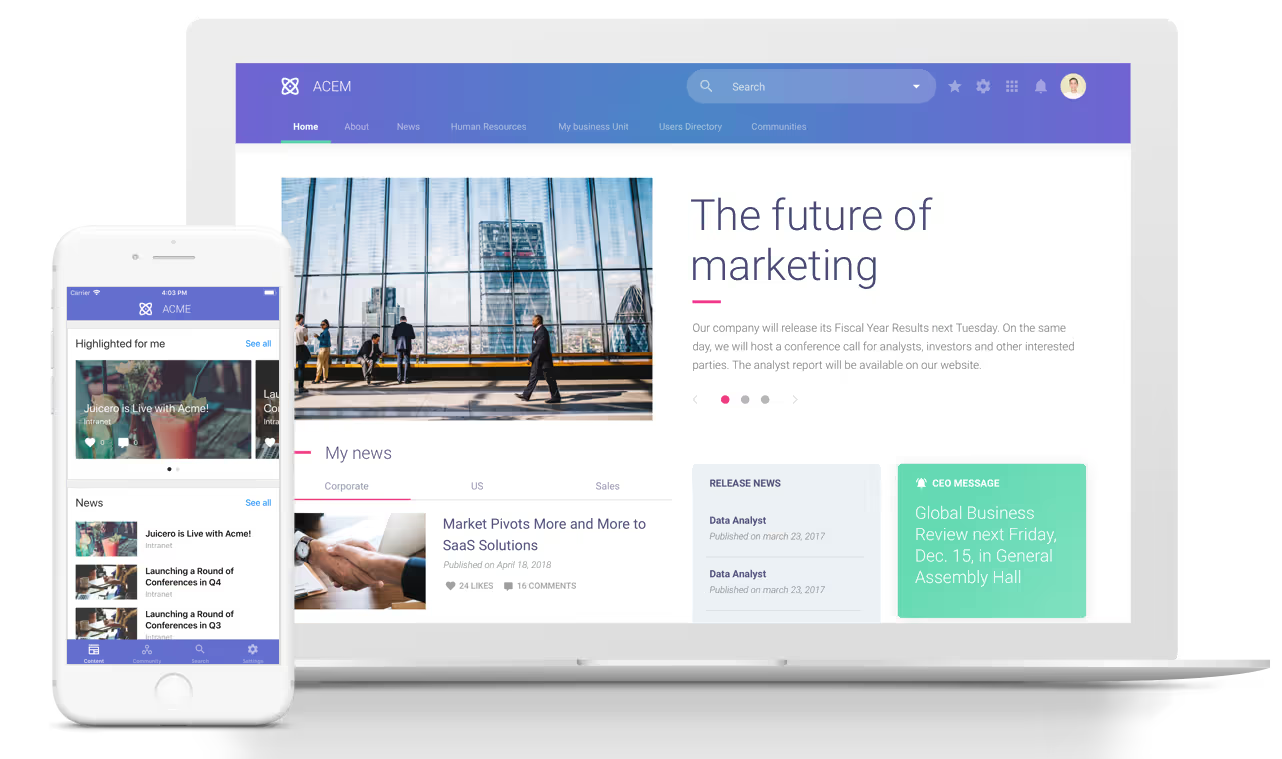
LumApps is designed as a connected employee hub that supports enterprise intranet needs at scale, across complexity, and amid change. It serves as a central layer that brings communication, resources, and access to work tools into a single environment.
For large organizations, this means the intranet can remain consistent as the ecosystem evolves. LumApps supports integration across major productivity environments, including Google Workspace and Microsoft 365, helping enterprises meet employees where they already work.
LumApps supports the capabilities enterprises need most: targeted communications, dependable access to knowledge, integrated workflows, personalized experiences, and deep measurement.
Implement an Enterprise Intranet That Scales With Your Organization
An enterprise intranet is an evolving infrastructure that supports communication, knowledge access, governance, and day-to-day work across distributed teams.
Enterprise intranets perform best when structure and ownership are designed in from the start. Over time, clear ownership keeps content current, maintains relevance, and helps the intranet stay part of daily work.
A scalable intranet approach connects the dots with a clear structure, core enterprise system integrations, and analytics to support ongoing improvement.
The LumApps Employee Hub is built to support enterprise requirements at scale and offers best practices for launching a new enterprise intranet, among many more features. To see it in action, watch a video demo.
FAQ: Enterprise Intranet
What Are the Must-Have Capabilities of a Modern Enterprise Intranet?
At enterprise scale, baseline requirements include:
- Role- and context-based personalization.
- Search and knowledge access.
- Deep integration with core systems.
- Governance and permissions.
- Analytics.
- Mobile access.
These capabilities need to work together to support daily work across complex organizations.
How Do You Drive Adoption of an Enterprise Intranet After Launch?
Adoption depends on sustained relevance, usability, and trust. Keep ownership clear, align the intranet to daily workflows, and maintain accurate, easy-to-find information over time.
How Should an Enterprise Intranet Handle Governance, Ownership, and Permissions at Scale?
Governance must be formal, distributed, and clearly defined across IT, communications, HR, and business teams. Role-based permissions and content lifecycle ownership help maintain consistency and accountability without over-centralizing control.
What Should an Enterprise Intranet Integrate With, and Why Does It Matter?
An enterprise intranet should integrate with productivity suites, HR systems, collaboration tools, and key line-of-business applications to reduce fragmentation. Integration depth directly affects usability, adoption, and long-term scalability.
How Do You Measure Enterprise Intranet Success Beyond Page Views?
Look beyond page views and clicks to indicators like findability, task completion, adoption across roles and regions, content relevance, and sustained usage trends. These measures show whether the intranet is improving how employees access information and get work done.