L'IA au service du business : transformer le battage mediatique en leadership et croissance

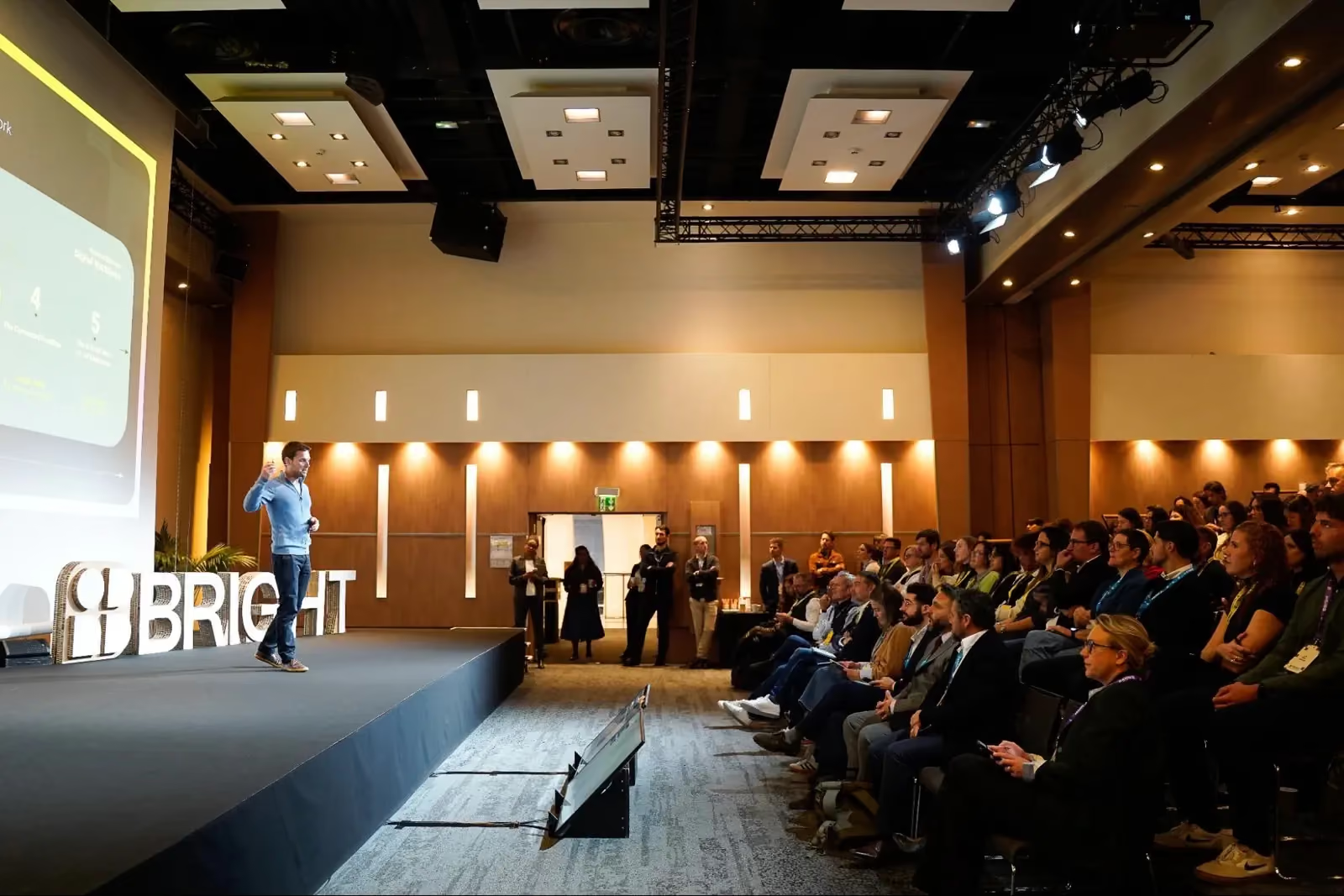
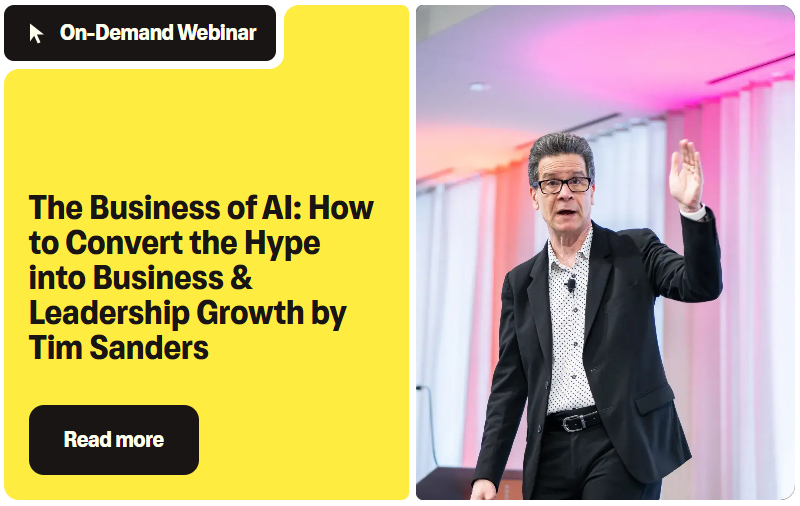
Artificial intelligence (AI) isn’t just a buzzword. It’s not something for tomorrow—it’s here, and it’s transforming the way businesses think, operate, and grow. But how do you move beyond the noise, the buzz, and the headlines? How do you take advantage of AI in ways that don’t just keep you competitive today, but position you as a leader for the future? These are the questions Tim Sanders, renowned business thinker, tackled head-on in his keynote at Bright Conference, “The Business of AI: How to Convert the Hype into Business Leadership and Growth.”
This blog captures the essence of his speech and will show you how you can harness AI to enhance your business operations, improve decision-making, and inspire innovation at every level of your organization.
The Big Picture of AI
Tim Sanders opened with a story borrowed from Steve Jobs, one that captures AI’s potential brilliantly. Jobs once described the computer as a “bicycle for the mind." The story stemmed from a 12-year-old Jobs reading Scientific American and learning that humans were relatively inefficient in terms of locomotion when compared to animals like the condor. But a human on a bicycle? That changed the game, putting humanity at the top of the efficiency ladder. For Jobs, computers were like bicycles—they augmented human abilities to get to destinations we could only imagine.
Fast forward to 2025, and Sanders paints an even bigger picture. If the computer was the bicycle of the mind, then AI, he says, is a turbo-charged vehicle like the kind you’d find on the racetrack—powerful, immediate, and capable of driving unimaginable progress.
But Sanders stressed a crucial warning here.
Too often, we get caught in the allure of the technology itself—the glossy exterior—when the real value lies in what we do with the tool.
Artificial Intelligence, Electrified
Sanders likened AI to another revolutionary force—electricity. People credit electricity with powering the Industrial Revolution, but it wasn’t electricity alone. The light bulb—Thomas Edison’s groundbreaking invention—was the actual game-changer. It illuminated factories, enabling night shifts. It lit streets, transforming cities into safe, vibrant ecosystems. It signaled an era when humans could work smarter, not harder.
AI is like electricity in 2025. It’s not the foundation—it’s the catalyst. With AI, predictions have become so sophisticated and affordable that businesses can now solve complex problems in ways they couldn’t before. Sanders emphasized AI’s real magic lies in its ability to democratize intelligence.
AI as a Prediction Machine
At its core, AI is a prediction machine. It takes the data you have and generates the data you don’t. Whether it’s predicting which customers are likely to purchase your product or generating an entire business report, AI revolves around this simple yet powerful concept of prediction.
Initially, machine learning provided simple, binary predictions—yes or no, fraud or legitimate. Generative AI, however, has taken this a step further by producing entire artifacts, such as paragraphs, reports, designs, or even images. This evolution has opened up remarkable use cases, from automating customer service responses to creating storyline drafts for marketing campaigns.
But what makes this so monumental is its shift in how businesses handle decisions.
The Decoupling of Prediction and Judgment
Sanders highlights an unprecedented shift AI has created in decision-making. Before AI, prediction and judgment—analyzing data and acting on it—lived within human expertise. Experts were highly paid because they combined both skills. But AI has decoupled the two. AI handles prediction, creating information at a scale and speed no human could. Now, humans are left to focus on judgment—deciding what to do with those predictions.
This shift is profound. It elevates the role of judgment in organizations and opens the door to hiring individuals not just for their credentials but for their ability to evaluate, decide, and adapt in the face of new information.
Take the analogy Sanders drew to Rick Rubin, the celebrated record producer, who famously has no hands-on technical skills. He doesn’t play instruments or operate soundboards, but his judgment—his ability to know what’s great and what isn’t—is what turns music into magic. AI can be your organization’s prediction engine, but it’s your team’s collective judgment that determines greatness.
Practical Business Applications of AI
Sanders walked through some incredible examples of how AI is reshaping industries and solving long-standing challenges.
1. Talent Acquisition and Onboarding
Many companies struggle to hire specialists who meet hyper-specific requirements, from years of experience to niche talents. But Sanders showed how a music equipment retailer eliminated this bottleneck by implementing an AI-powered copilot. This tool replaced the need for extensive musical expertise during onboarding, allowing faster training and improved employee productivity.
2. Customer Engagement and Retention
Sanders explained how prediction can revolutionize customer-facing processes. Consider Gucci, which used AI to coach customer service agents, increasing their ability to upsell while automating support for routine product questions. Staff became more productive while offering a better customer experience.
3. Streamlining Operations
AI can cut through inefficiencies by surfacing actionable insights from data. Sanders illustrated this with an example from benefits providers. A client struggling to encourage 401(k) enrollment used generative AI to analyze the user interface and eliminate bottlenecks in the sign-up process, ultimately driving higher engagement.
Shifting from Expertise to Judgment
One of Sanders’ core arguments is that AI is lowering the cost of expertise, and companies should adapt fast. Instead of hiring only for years of experience or technical mastery, pivot your talent strategy towards individuals with excellent judgment skills.
He pointed out that tech companies often repeat the mistake of holding onto knowledge workers who are specialists in obsolete processes while overlooking forward-thinking generalists. AI is accelerating change too quickly to cling to traditional hiring philosophies.
Six Steps to Get Business Value from AI
If you’re ready to make AI a driver of growth and leadership, Sanders offered a six-step approach to get started.
- Start with the Problem, Not the Technology : AI isn’t a solution looking for a problem. Begin by identifying your company’s biggest friction points—whether they’re in operations, customer experience, or supply chain management—and work backward to determine if AI can help.
- Reframe Problems as Prediction Challenges : Rethink common business inefficiencies. For example, hiring delays aren’t a talent pipeline issue—they’re prediction problems about assessing fit. Translate your pain points into prediction opportunities.
- Evaluate and Align with Data : Make sure your organization has the data necessary to power AI models, and evaluate how predictive outputs align with your business goals.
- Measure Task Utilization, Not ROI : Instead of obsessing over broad ROI figures, track how often teams actively use AI tools in their workflows. Greater adoption almost always equals greater return.
- Trust Through Deliberate Practice : Employees need hands-on experience with AI to trust it. Set up deliberate practice opportunities so they can experiment, refine prompts, and build confidence in the tools.
- Aspire for Autonomy : Humans in the loop are a temporary fix. Aim for systems that handle repeatable tasks autonomously, whether they’re task agents, process agents, or multi-agent systems.
The Case for Bold Actions with AI
Sanders closed his keynote with an inspiring call to action. He reminded us that trust gaps—the psychological and emotional barriers to adopting new technology—can paralyze organizations. To thrive in the AI age, companies must cultivate a culture of exploration, experimentation, and learning.
AI isn’t coming for jobs; it’s coming to multiply what we’re capable of. The businesses that thrive tomorrow will be the ones that invest today in teaching their teams not just how to use AI, but how to trust it.
The real question isn’t whether AI will change your industry; it’s whether you’ll lead that change or struggle to catch up.
Final Thoughts
Artificial intelligence has the potential to turbocharge progress just like the lightbulb once powered the Industrial Revolution. But the value lies in how businesses choose to use this powerful tool. By starting with the right questions and fostering an environment of confident experimentation, companies can find themselves not just riding the wave of AI innovation but defining its direction.
Now’s the time to take the wheel. What’s your roadmap for AI success?

_en_opt.avif)